
Visual and microbiological evaluation of the soil in two suburban farms of Santiago de Cuba
Article Sidebar
Main Article Content
Abstract
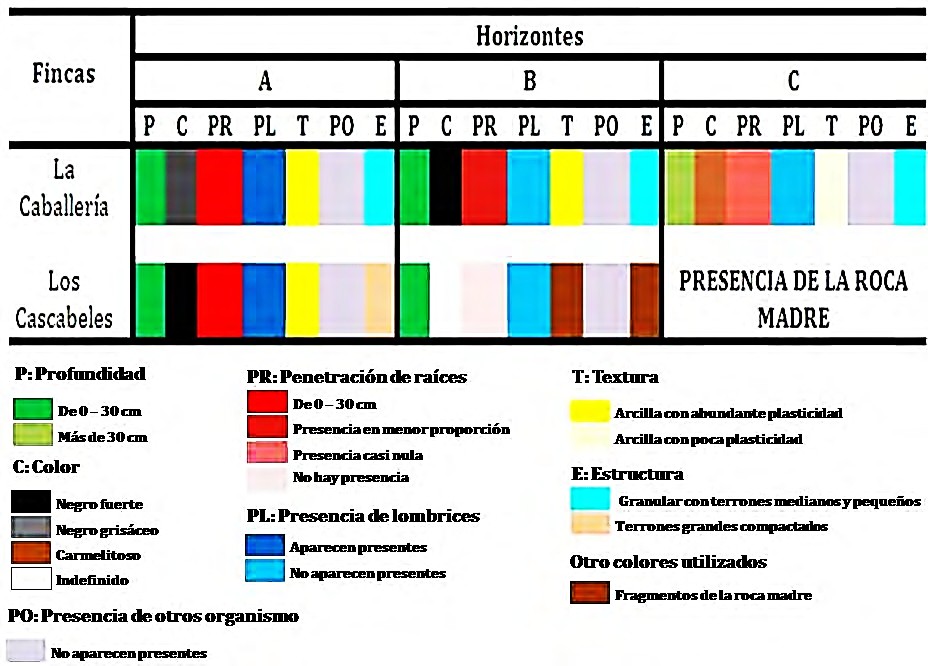
In order to evaluate visual and microbiological soil quality two suburban farms, research was developed on farms La Caballería and Los Cascabeles of Santiago de Cuba municipality and in the Laboratory of Microbiology, Faculty of Agricultural Sciences of the Universidad Central de Las Villas. A visual quality assessment, the qualitative description of profile in addition to the taking of soil samples, which were analyzed in the laboratory by the method of plate count from which the number of forming units was quantified performed colonies present in the sample, They described their cultural characteristics and samples for observation and identification were prepared to genus level in the case of fungi. The results obtained show that both farms floors have good quality from a visual point of view although not all indicators reach acceptable values. The better performance of microorganisms in general was reached on the farm The Bells in which there were two genera of fungi that are used as antagonists in biological control.
Article Details

This work is licensed under a Creative Commons Attribution-NonCommercial 4.0 International License.
Those authors who have publications with this journal accept the following terms of the License Attribution-NonCommercial 4.0 International (CC BY-NC 4.0):
You are free to:
- Share — copy and redistribute the material in any medium or format
- Adapt — remix, transform, and build upon the material
The licensor cannot revoke these freedoms as long as you follow the license terms.
Under the following terms:
- Attribution — You must give appropriate credit, provide a link to the license, and indicate if changes were made. You may do so in any reasonable manner, but not in any way that suggests the licensor endorses you or your use.
- NonCommercial — You may not use the material for commercial purposes.
- No additional restrictions — You may not apply legal terms or technological measures that legally restrict others from doing anything the license permits.
The journal is not responsible for the opinions and concepts expressed in the works, they are the sole responsibility of the authors. The Editor, with the assistance of the Editorial Committee, reserves the right to suggest or request advisable or necessary modifications. They are accepted to publish original scientific papers, research results of interest that have not been published or sent to another journal for the same purpose.
The mention of trademarks of equipment, instruments or specific materials is for identification purposes, and there is no promotional commitment in relation to them, neither by the authors nor by the publisher.
How to Cite
References
Coleman, C., Crossley, A., y Hendrix, P. (2004). Fundamentals of soil ecology. Second Edi. Elsevier Academic Press: Burlington.
Conti, M. E., & Giuffré, L. (2011). Edafología, bases y aplicaciones ambientales argentinas. Buenos Aire: UBA. 656 p.
Demián, L. (2012). Comunidades baterianas en suelos bajo siembra directa en la región agropecuaria pampeana. Influencia del manejo y propuesta de nuevos indicadores. Tesis presentada para optar al título de Doctor de la Universidad Buenos Aires en el Área de Química Biológica. 130. Buenos Aires, Cuba: Universidad de Buenos Aires.
Escobar, Y. (2016). Evaluación de la calidad del suelo en fincas de la agricultura suburbana en el municipio Santiago de Cuba. Tesis presentada en opción al título de Ingeniero Agrónomo, 47. Santiago de Cuba, Santiago de Cuba, Cuba: Universidad de Oriente.
Escobar, Y., Vargas, B., Fuentes, O., Rodríguez, O., & Molina, L. B. (2017). Evaluación visual de la calidad en cuatro fincas de la agricultura suburbana de Santiago de Cuba. Ciencia en su PC, 3, 13-28.
Infante, D., Martínez, B., González, N., & Reyes, Y. (2009). Mecanismos de acción de Trichoderma frente a hongos fitopatógenos. Protección Vegetal 24(1): enero –abril.
Jaramillo, D. (2011). Caracterización de la materia orgánica del horizonte superficial de un andisol hidromórfico del oriente antioqueño (Colombia). Academia Colombiana de Ciencia, 35(134): 23-33.
Lambert, T. (2010). Identificación, menejo y conservación de suelo con el empleo de métodos participativos en la comunicadad "La Concepción". Tesis presentada en opción al título académico de Master en Ciencias en Gestión Ambiental, 76. Bayamo: Universidad de Granma.
Lecuona, R. (1996). Control microbiano, utopía o realidad (p. 13-15). En R. Lecuona, Microorganismos patógenos empleados en el control microbiano de insectos plaga (pág. 338). Buenos Aires, Argentina: Mariano Mas.
Martínez, B., Infante, D., & Reyes, Y. (2013). Trichoderma spp. y su función en el control de plagas en los cultivos. Protección Vegetal, 28(1): enero –abril.
Osorio, W., & Osorno, L. (2013). Microorganismos del suelo y su efecto en la disponibilidad de nutrientes. Medellín: Universidad Nacional de Colombia.
Pastor, S. (18 de junio de 2004). Biomonitorización citogenética de cuatro poblaciones agrícolas europeas, expuestas a plaguicidas, mediante ensatos de micronúcleos. Recuperado el 20 de enero de 2015, de http://www.tdx.cesca.es
Vargas, B., Martinella, A., Rizo, M., Candó, L., & Ramírez, B. (2014). Algunas variables que inciden en las condiciones edafoclimáticas del huerto intensivo El Vivero. Ciencia en su PC, (1): 72 – 81: enero – marzo.
Vargas, B., Pupo, B., Fajardo, L., Puertas, A., & Viera, Y. (2015). Relación potencial con cultivos agrícolas de la diversidad micológica asociada a Lippia dulcis, Lantana camara y Cleome viscosa. Granma Ciencia, 19(1): enero – abril.