
Use of acid peat as amendment for alkalinized rhodic Ferralsol soils in tobacco areas of Artemisa, Cuba
Article Sidebar
Main Article Content
Abstract
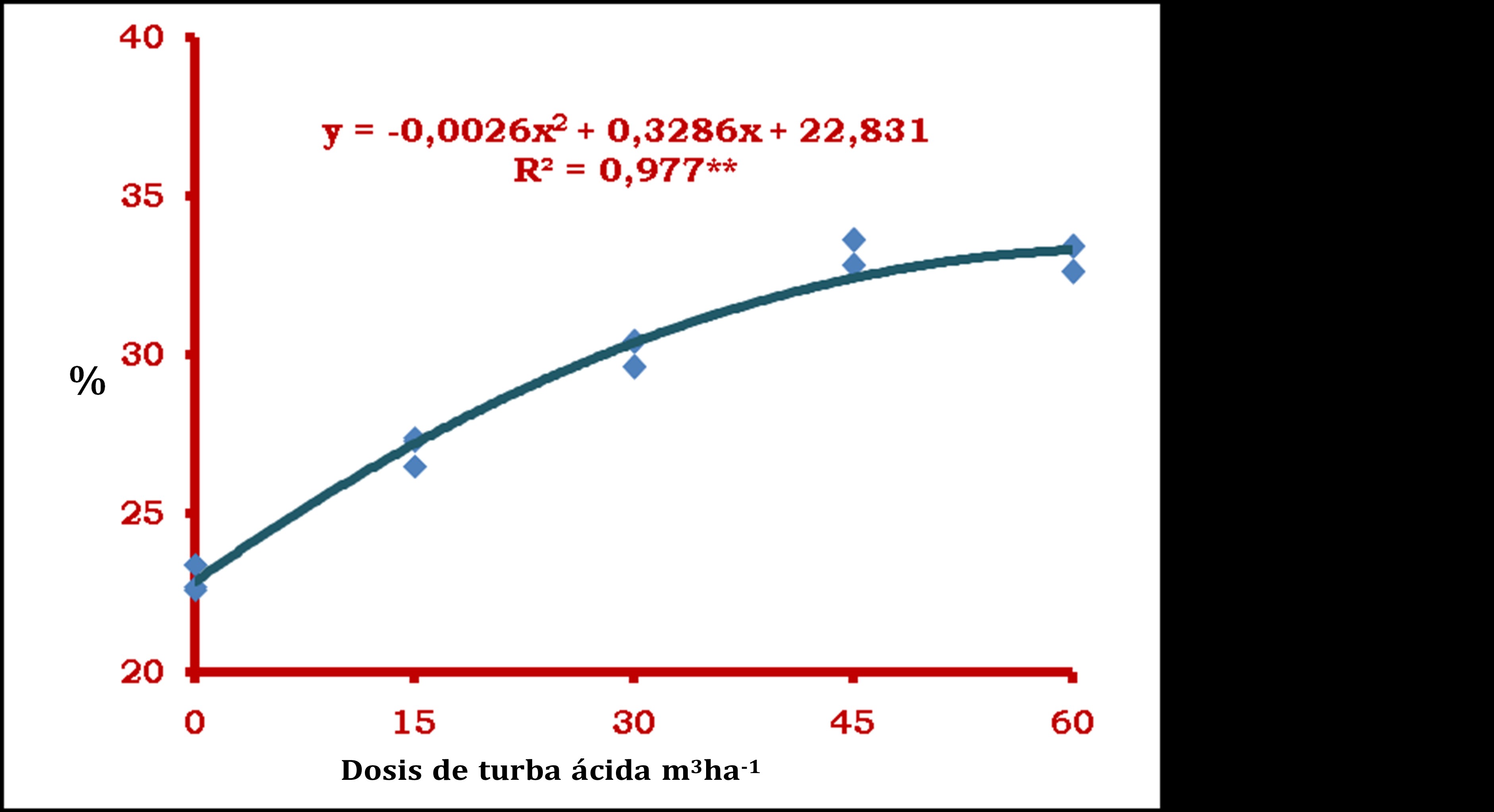
Affectations derived from pH increases in tobacco soils of the Ferralsol group typical in the Alquízar municipality, Artemisa province, primarily in the Partido region ~protected denomination of origin~ have made the recovery of tobacco (Nicotiana tabacum L.) quality grown there and mainly used to export a priority. In this context and as an alternative to the use of sulphur as amendment agent, the effects of acid peat applications to the soil (0; 15, 30, 45 y 60 m³.ha-¹) were evaluated on its acidity and the production with exportable commercial quality. The organic fertilizer can be used in the pH correction of these tobacco soils, degraded as a result of continuous farming and climate irregularities; the doses of 45 and 60 m³.ha-¹ produced the most favourable effects in this respect. As for the farming production with exportable commercial quality, the dose of 45 m³.ha-¹ led to increases for that indicator of production effiency of up to 10% with respect to the no application of acid peat and without any statistical differences compared to the maximum dose evaluated; a critical level (7.52) is recommended for the pH of the Rhodic Ferralsol tobacco soils in the Partido region, located in the Alquízar municipality, as determining factor of the commercial value for the production obtained.
Article Details

This work is licensed under a Creative Commons Attribution-NonCommercial 4.0 International License.
Those authors who have publications with this journal accept the following terms of the License Attribution-NonCommercial 4.0 International (CC BY-NC 4.0):
You are free to:
- Share — copy and redistribute the material in any medium or format
- Adapt — remix, transform, and build upon the material
The licensor cannot revoke these freedoms as long as you follow the license terms.
Under the following terms:
- Attribution — You must give appropriate credit, provide a link to the license, and indicate if changes were made. You may do so in any reasonable manner, but not in any way that suggests the licensor endorses you or your use.
- NonCommercial — You may not use the material for commercial purposes.
- No additional restrictions — You may not apply legal terms or technological measures that legally restrict others from doing anything the license permits.
The journal is not responsible for the opinions and concepts expressed in the works, they are the sole responsibility of the authors. The Editor, with the assistance of the Editorial Committee, reserves the right to suggest or request advisable or necessary modifications. They are accepted to publish original scientific papers, research results of interest that have not been published or sent to another journal for the same purpose.
The mention of trademarks of equipment, instruments or specific materials is for identification purposes, and there is no promotional commitment in relation to them, neither by the authors nor by the publisher.
How to Cite
References
Barbagelata, P.A.; Melchiori, R. J. M. y Paparotti, O. P. (2001). Fertilización fosfatada del cultivo de Soja en suelos Vertisoles de la provincia de Entre Ríos. Informaciones Agronómicas del Cono Sur, Nº11, Septiembre.
Bernal, A. (2009). Influencia antropogénica y de las condiciones climáticas en la estabilidad estructural de los agregados de los suelos Ferralíticos Rojos lixiviados y Pardos de la provincia de La Habana. --La Habana: Ediciones INCA, 63 pp.
Cánepa, Y.; Trémols, J.; Hernández, A.; Monzón, L. y Valiente, M.C. (2012). La degradación química en suelos Ferralíticos Rojos de la Empresa Tabacalera “Lázaro Peña”. Cuba Tabaco, 13(1): 69-73. ISBN: 0138-7456.
Cánepa, Y.; Trémols, J.; González, A. y Hernández, A. (2015). Situación actual de los suelos tabacaleros de la Empresa “Lázaro Peña” de la provincia de Artemisa. Cultivos Tropicales, (36)1: 80-85.
Cate, R.B. y Nelson, L.A. (1971). A Simple Statistical Procedure for Partitioning Soil Test Correlation Data Into Two Classes. Soil Science Society of America Journal 35:658-660. Doi: 10.2136/sssaj1971.03615995003500040048x.
Colectivo de autores. (2012). Instructivo Técnico para el Cultivo del Tabaco en Cuba. --Artemisa: Instituto de Investigaciones del Tabaco, 148 pp. ISBN: 978-959-7212-07-2.
Dirección General de Suelos y Fertilizantes (DGSF). (1984). Manual de interpretación de análisis de los suelos. La Habana, CUBA. Editorial Científico-Técnica, 136 pp.
De Barros, O.; Siqueira y de Souza, F. (2005). Avaliação agronômica de um biossólido industrial para a cultura do milho. Pesquisa Agropecuaria Brasileira, Brasília, (40) 3: 261-269.
Devi, K.N.; Singh, M.S.; Singh, N. G. y Athokpam, H. S. (2011). Effect of integrated nutrient management on growth and yield of wheat (Triticum aestivum L.). Journal of Crop and Weed, 7(2): 23-27.
Dey, A.; Dasgupt, S.; Bhattarcharya, S.; Chaitanya, A.K.; Pati, S. y Pal, B. (2015). Soil physical fertility and performance of potato crop as affected by integration of organic and inorganic fertilizers in new alluvial soil of West Bengal. Journal of Crop and Weed, 11(1):132-137.
Febles, J.M.; Vega, M.B.; Do Amaral, N.; Tolón, A. y Lastra, X. (2014). Good Soils in Extinction: Degradation of Red Ferralitic Soils in Western Cuba. Soil Science, 179 (6): 304-313. Doi: 10.1016.
González, A., Trémols, J.; Cánepa; Y. y González, R. (2010). Efectos de algunos procesos degradativos sobre propiedades de los suelos Ferralíticos rojos dedicados al cultivo del tabaco tapado. Cuba Tabaco, (11) 2: 24-29.
Gutiérrez, L.; Arozarena, N.J.; Rodríguez, A.; Castañeda, E.; Lozano, S. y Rodríguez, G. (2015). Nutrición biorganomineral: una alternativa para elevar la producción de pimiento ‘Verano-1’ en organoponía semiprotegida. Agrotecnia de Cuba, 39(6): 35-45.
Hernández, A.; Pérez, J.; Bosch, D. y Rivero, L. (1999). Nueva versión de clasificación genética de los suelos en Cuba. --La Habana: Agrinfor, 64 pp. ISBN 959-246-022-1.
Hernández, A.; Morales, M.; Borges, Y.; Vargas, D.; Cabrera, A.; Ascanio, M.O. y González, P.L. (2014). Degradación de las propiedades de los suelos Ferralíticos Rojos lixiviados de la “Llanura Roja de La Habana” por el cultivo y algunos resultados sobre su mejoramiento. -- Mayabeque (Cuba): Ediciones INCA. 156pp. ISBN: 978-959-7023-66-1.
Instituto de Investigaciones del Tabaco. (2012). El Mundo del Habano. --La Habana: Agrinfor, 187 pp. ISBN 978-959-7212-04-1.
Mangiafico, S. (2013). Cate-Nelson Analysis for Bivariate Data Using R-project. Journal of Extension (51) 5 Article # 5TOT1, 9 pp.ISSN 1077-5315.
ONEI (Oficina Nacional de Estadística e Información). (2015). Anuario Estadístico Oficina Nacional de Normalización (NC). (1999). Calidad del Suelo. Determinación de pH. NC ISO 10390. --La Habana: Oficina Nacional de Normalización; 1ra. edición. 22 pp.
Pullicino, D.S.; Massaccesia, L.; Dixonb, L.; Bolb, R. y Gigliottia, G. (2009). Organic matter dynamics in a compost-amended anthropogenic landfill capping-soil. European Journal of Soil Science, 61: 35- 47.
Simonete, M. A.; de Castro, J.; Andrade, C.A. y Almeida, C.F. (2003). Efeito do lodo de esgoto em um Argissolo e no crescimento e nutrição de milho. Pesquisa Agropecuaria Brasileira, Brasília, (38) 10: 1187-1195.
Valladares, R. (2003). Instructivo para el Acopio y Beneficio del Tabaco Negro Tapado. -- La Habana: Agrinfor, 59 pp. ISBN: 959- 246-067-1.