
Species of Alternaria fungi genus lodged in vegetables, grains and oleaginous seeds.
Article Sidebar
Main Article Content
Abstract
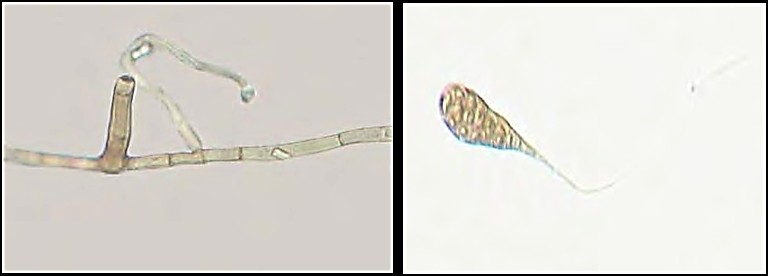
With the aim of providing new experiences and enlarge knowledges for sanitary quality diagnose of seeds being handled in germplasm collections, genetic improvement programs and seed production schemes, are given descriptions of 13 phytopathogenic fungi belonging to Alternaria genus that have been found lodging in vegetable, grains and oleaginous seeds produced under Cuban conditions. Novel graphic elements and descriptions are basic informations for that purpose.
Article Details

This work is licensed under a Creative Commons Attribution-NonCommercial 4.0 International License.
Those authors who have publications with this journal accept the following terms of the License Attribution-NonCommercial 4.0 International (CC BY-NC 4.0):
You are free to:
- Share — copy and redistribute the material in any medium or format
- Adapt — remix, transform, and build upon the material
The licensor cannot revoke these freedoms as long as you follow the license terms.
Under the following terms:
- Attribution — You must give appropriate credit, provide a link to the license, and indicate if changes were made. You may do so in any reasonable manner, but not in any way that suggests the licensor endorses you or your use.
- NonCommercial — You may not use the material for commercial purposes.
- No additional restrictions — You may not apply legal terms or technological measures that legally restrict others from doing anything the license permits.
The journal is not responsible for the opinions and concepts expressed in the works, they are the sole responsibility of the authors. The Editor, with the assistance of the Editorial Committee, reserves the right to suggest or request advisable or necessary modifications. They are accepted to publish original scientific papers, research results of interest that have not been published or sent to another journal for the same purpose.
The mention of trademarks of equipment, instruments or specific materials is for identification purposes, and there is no promotional commitment in relation to them, neither by the authors nor by the publisher.
How to Cite
References
ECURED (2018): Alternaria alternata. https://www.google.com/search?q=Alternaria &ie=utf-8&oe=utf-8&client=firefox-b. Consultado 20 de abril de 2018.
Ellis, M.B. (1971): Dematiaceous hyphomycetes. Commonwealth Mycological Institute. Kew, Surrey. England, 608 pp. SBN 85198 027.
Ellis, M.B. (1976): More dematiaceous hyphomycetes. Commonwealth Mycological Institute. Kew, Surrey. England, 507 pp. ISBN 0 85198 365 0.
Mathur, S.B. y Kongsdal, O. (2003): Common laboratory seed health testing methods for detecting fungi. International Seed Testing Association. 425 pp. ISBN 3-906549-35-6.
Machado, J.C. (2000): Tratamento de sementes no controle de doenças. LAVRAS/UFLA/FAEPE. Brasil. 138 pp.
McAboy, G. (2018): Una solución para la mancha foliar por Alternaria. http://www.hortalizas.com/cultivos/una-solucion-para-la-mancha-foliar-por-alternaria (Consultado de 15 de marzo de 2018).
Neergaard, P. (1979): Seed pathology. The Mc Millan Press LTD. London. Vol. I y II. 1191 pp. ISBN 0 333 19273.
Simmons, E.G. (2016): Novel dematiaceous hyphomycetes. http://www.cbs.knaw.nl/publications/1050/012No vel%20dematiaceous%20hyphomyceees.pdf. (Consultado 15 de noviembre de 2017).
Zambrano, M.G. (2018): Alternaria helianthi. https://wiki.bugwood.org/Alternaria_helianthi (Consultado 15 de marzo de 2018)