
Phytotoxicity test to evaluate maturity gradation in organic fertilizers
Article Sidebar
Main Article Content
Abstract
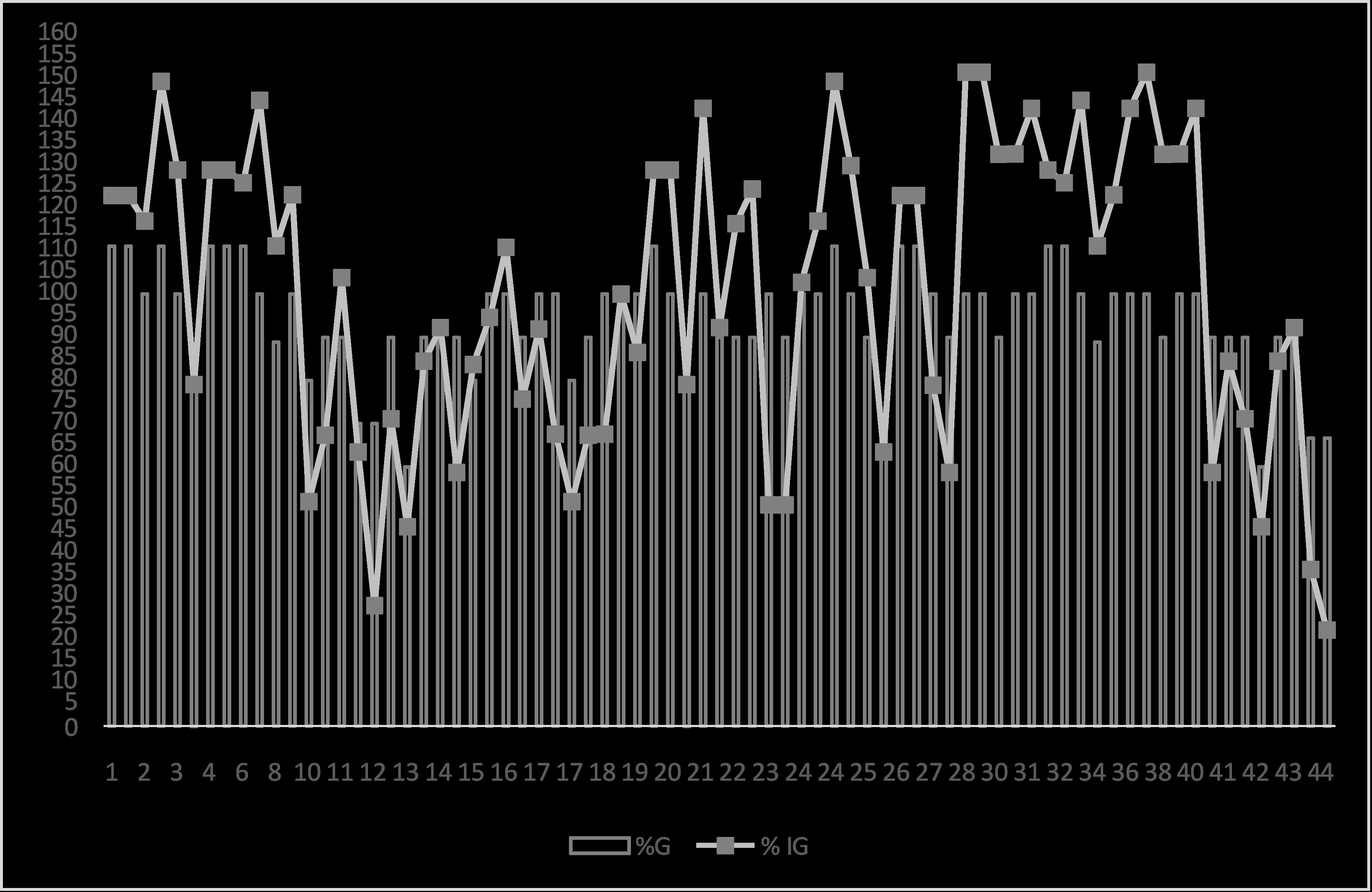
The maturity of the compost can be determined by germination assays using plants species sensitive to phytotoxic metabolites. These substances should be transformed or immobilized during the maturity phase of the composting process, leading to a biological stable material with very low phytotoxicity. This work intended to introduce the Zucconi´s phytotoxicity test in order to establish a quick method to evaluate the maturity gradation of organic fertilizers. The application of this method discard the use of organic fertilizers with low quality. Consequently it can be avoid the possible adverse effects on plant, soil and environment, preventing the release of phytotoxic substances affecting crops development. The germination index (GI) was determined using seeds of Raphanus sativum in 44 compost samples of the production areas. According to the results, the 67 % of the production areas showed values of GI ≥80%, representing no presence of phytotoxic substances; the 7 % showed GI≤50% indicating strong presence of such elements and the 26 % presented values between 50 to 80 % showing moderated presence of these substances. The application of this methodology reinforce the importance of the GI, being a more sensitive parameter than the germination percentage when evaluating the phytotoxic potential of an organic material. Our results showed the effectiveness of the method to determine the maturity of the compost.
Article Details

This work is licensed under a Creative Commons Attribution-NonCommercial 4.0 International License.
Those authors who have publications with this journal accept the following terms of the License Attribution-NonCommercial 4.0 International (CC BY-NC 4.0):
You are free to:
- Share — copy and redistribute the material in any medium or format
- Adapt — remix, transform, and build upon the material
The licensor cannot revoke these freedoms as long as you follow the license terms.
Under the following terms:
- Attribution — You must give appropriate credit, provide a link to the license, and indicate if changes were made. You may do so in any reasonable manner, but not in any way that suggests the licensor endorses you or your use.
- NonCommercial — You may not use the material for commercial purposes.
- No additional restrictions — You may not apply legal terms or technological measures that legally restrict others from doing anything the license permits.
The journal is not responsible for the opinions and concepts expressed in the works, they are the sole responsibility of the authors. The Editor, with the assistance of the Editorial Committee, reserves the right to suggest or request advisable or necessary modifications. They are accepted to publish original scientific papers, research results of interest that have not been published or sent to another journal for the same purpose.
The mention of trademarks of equipment, instruments or specific materials is for identification purposes, and there is no promotional commitment in relation to them, neither by the authors nor by the publisher.
How to Cite
References
Atravia, S, Uribe, L, Saborío, F, Arauz, L y Castro, L (2010): Efecto de la aplicación de abonos orgánicos en la supresión de Pythium myriotylum en plantas de tiquis que (Xanthosoma sagittifolium). Agronomía Costarricense, 34(1),ISSN 0377-9424
Emino, E., Warman, P (2004): Biological assay for compost quality. En: Compost Science & Utilization, 12(4): 342-348.
Escobar, J; Pereira, L; Martínez, Y y Sánchez, N (2012): Evaluación de la fitotoxicidad de lodos residuales de industrias alimenticias y papeleras. XIX Congreso Latinoamericano de la Ciencia del Suelo. Mar del Plata, Argentina.
Hernández, R. O., Hernández, A., Rivera, C., Arras, A y Ojeda, D (2013): Calidad nutrimental de cuatro abonos orgánicos producidos a partir de residuos vegetales y pecuarios. Terra Latinoamericana, 31(1), ISSN (Versión impresa): 1870-9982.
Hernández, R. O.,Arras, A., López, D., Moreno, M., Ojeda, B y Cabral, M (2011): Índice de fitotoxicidad de enmiendas orgánicas en lechuga (Lactuca sativa L). Rev. Mexicana Agroneg,15: 123-130.
Mazzarino, M, Satti, P y Roselli, L (2012): Indicadores de estabilidad, madurez y calidad de compost. En el Libro Compostaje en la argentina: Experiencias de producción, calidad y uso. lra ed. ISBN978-987- 9260-93-7
Nogales, R., Elvira, C., Benítez, E y Gallardo Lara, F (1995): Uso Agrícola de Compost y Vermicompost de Basuras Urbanas (I): Procesos, Madurez y calidad de los Productos. ¨Residuos¨. Año V. N 26.
Nogales, R.; Romero, E y Fernández, M. J. (2014): De residuo a recurso. El camino hacia la sostenibilidad.Mundi-Prensa. 172 p
Pérez, A (2011): Humus de lombriz como materia prima en la elaboración de sustratos para la producción de plantines de hortalizas. Memoria para optar al título profesional de Ingeniero Agrónomo. Universidad de Chile. Facultad de Ciencias Agronómicas. Escuela de pregrado. 32 p Pérez, V., Bárbaro, L., Mata, D y Karlanian, M (2011): Caracterización y acondicionamiento de diferentes compost de restos de poda para su uso como componente de sustrato en la producción de especies florales. Rev. Facultad Agronomía. UM - Vol. II Nº4 ISSN 2250 6373, 35-65
Varnero, MT., Orellana, R., Rojas, C., Santibañes, C (2006): Evaluación de especies sensibles a metabolitos fitotóxicos mediante bioensayos de germinación. El Medioambiente en Iberoamérica: Visión desde la Física y la Química en los albores del Siglo XXI. (Ed) Juan F. Gallardo Lancho. Sociedad Iberoamericana de Física y Química Ambiental. Badajoz, España. Tomo III, 363-369.
Varnero, MT., Rojas, C., Orellana, R. (2007): Índices de fitotoxicidad en residuos orgánicos durante el compostaje. J. Soil Science Nutr, 7 (1); 28-37
Wu, L. y Martinez G.A. (2000): Comparison of methods for evaluating stability and maturity of biosolids compost. Journal of Environmental Quality, 29:424-429
Zubillaga, M.,Branzini, A y Lavado, R (2008): Problemas de fitotoxicidad en compost. Revista Pilquen, X (9).
Zucconi, F., Pera, A., Forte, M y De Bertoli, M. (1981): Evaluating toxicity in immature compost. Biocycle, 22: 54–57.