
Identification of common beans ( Phaseolus vulgaris L.) cultivars with drought tolerance
Article Sidebar
Main Article Content
Abstract
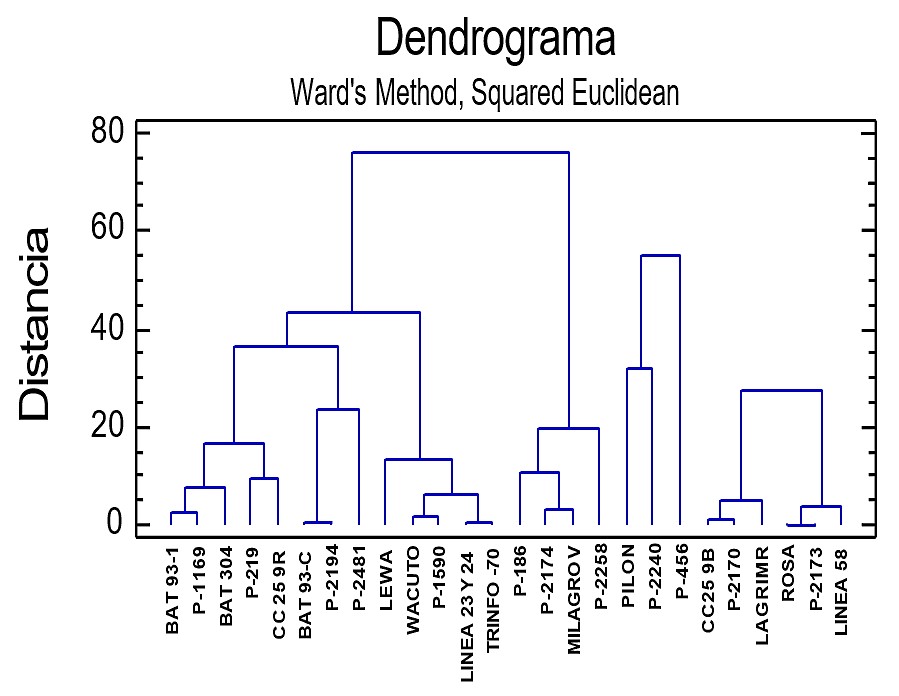
The yield of common beans (Phaseolus vulgaris L.) in Cuba during the last year was not higher than 1.7 t.haˉ¹. One of the most important causes of this fact is there are not enough cultivars that are adapted to drought stress. The objective of this paper was the identification of drought tolerance cultivars among common beans accessions of INIFAT Gene Bank. Seed of twenty six common bean cultivars were germinated in petri dishes with solutions of different Polyethyleneglycol (3, 6, 9, 12, 15, 18, 21% of PEG) concentrations, distillated water was used as control. The germination percentage, root and hypocotyls length were evaluated. The experimental data were analyzed by Analysis of Components Principal and Cluster. The results show that seventeen cultivars were identified as drought tolerant, six had a middle behavior and tree was susceptible.
Article Details

This work is licensed under a Creative Commons Attribution-NonCommercial 4.0 International License.
Those authors who have publications with this journal accept the following terms of the License Attribution-NonCommercial 4.0 International (CC BY-NC 4.0):
You are free to:
- Share — copy and redistribute the material in any medium or format
- Adapt — remix, transform, and build upon the material
The licensor cannot revoke these freedoms as long as you follow the license terms.
Under the following terms:
- Attribution — You must give appropriate credit, provide a link to the license, and indicate if changes were made. You may do so in any reasonable manner, but not in any way that suggests the licensor endorses you or your use.
- NonCommercial — You may not use the material for commercial purposes.
- No additional restrictions — You may not apply legal terms or technological measures that legally restrict others from doing anything the license permits.
The journal is not responsible for the opinions and concepts expressed in the works, they are the sole responsibility of the authors. The Editor, with the assistance of the Editorial Committee, reserves the right to suggest or request advisable or necessary modifications. They are accepted to publish original scientific papers, research results of interest that have not been published or sent to another journal for the same purpose.
The mention of trademarks of equipment, instruments or specific materials is for identification purposes, and there is no promotional commitment in relation to them, neither by the authors nor by the publisher.
How to Cite
References
Abebe, A; Brick, M. y Georgia, K. (2009): Evaluation of common bean entries for drought tolerant in Ethiopia, Proceeding of the Second International Scientific Meeting, CIAT, 351- 357.
Beebe, S.; Rao, I.M.; Cajiao, C. y Grajales, M. (2008): Selection for drought resistance in common bean also improves yield in phosphorus limited and favourable environments. Crop Sci. 48, 582-592.
Ho, M.D.; Rosas, J.C.; Brown, K.M. y Lynch, J.P. (2009): Root architecture tradeoffs for water and phosphorus acquisition. Funct. Plant Biol. 32, 737-748.
Pliego- Marín, J.; López Baltasar, E. y Robles, A. (2013): Características físicas nutricionales y capacidad germinativa de frijol común criollo bajo condiciones de estrés hídrico. Revista Mexicana de Ciencias Agrícolas. Pub. Esp. Num. 6, 1197- 1209.
Michel, B.E. y Kaufmann, M.R. (1973): The osmotic potential of polyethylene glycol 6000. Plant Physiol., 51: 914.
O.N.E. (2013): Disponible en www.one.cu. Consulta: 20 de abril de 2016.
Polaina, J., Idupulapati, A., Rao, M., Beebe, S. y García, R. (2009): Desarrollo y distribución de raíces bajo estrés por sequía en fríjol común (Phaseolus vulgaris L.) en un sistema de tubos con suelo. Agronomía Colombiana, 27(1), 25-32.
Rao, I.M., Beebe, S.; Polania, J.; Grajales, M.A. y García, R. (2009): Differences in drought resistance of advances lines developed for the last 3 decades. En: Project IP-1: Bean improvement for the tropics. CIAT Annual report 2006. CIAT, Cali, Colombia, 2-6.
Salinas, l. E; Tosquy, V. Ó. H.; Ugalde, A. F. y Acosta, G. J. A. (2010): Rendimiento y tolerancia a la sequia de genotipos de frijol negro en el Estado de Veracruz. Rev. Fitotec. México, 31 (Núm. Especial 3): 35 – 39.
Xoconostle, C.B; Gómez, S. L.; González de la Rosa, L. y Ruiz Medrano, R. (2010): Obtención de Nuevas Variedades de Frijol Tolerantes a Sequia en México, 25-30.