
Fungicidal activity of Cladobotryum strains against Corynespora cassiicola.
Article Sidebar
Main Article Content
Abstract
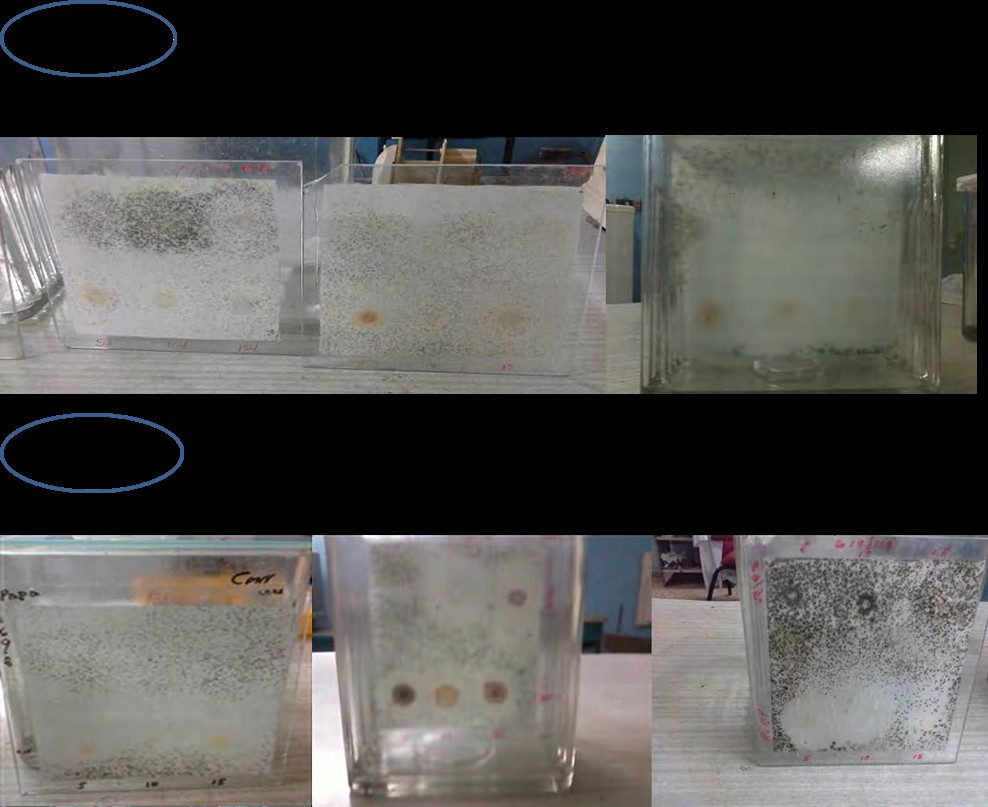
On the present paper were evaluated the fungicide activity of tree new Cladobotryum strains: C. pinarense (1789), C. semicirculare (1698) y C. virescens (C10/110) preserved on International recognized World Federation Culture Collections (WFCC 853) at INIFAT. The fungal strains were grown on potato and oat mediums by shaking condition for 5, 10 and 15 days. Subsequently, the broth cultures and ethyl acetate extracts obtained were tested against the phytopathogen Corynespora cassiicola by Dual Culture and Bioautographic TLC methods. All the Cladobotryum species had high antagonism against C. cassiicola acting by mycoparasitism, also favored this effect by the higher capacity of the strains to compete for the substrate. The ethyl acetate extracts showed inhibition of growth of the pathogen, in both culture media, on three days of fermentation studied. Those results are good for going on studying in these species referred to obtaining bioproducts to control of "ring spot" or "fire blight" disease on Integrated Management Program (IMP).
Article Details

This work is licensed under a Creative Commons Attribution-NonCommercial 4.0 International License.
Those authors who have publications with this journal accept the following terms of the License Attribution-NonCommercial 4.0 International (CC BY-NC 4.0):
You are free to:
- Share — copy and redistribute the material in any medium or format
- Adapt — remix, transform, and build upon the material
The licensor cannot revoke these freedoms as long as you follow the license terms.
Under the following terms:
- Attribution — You must give appropriate credit, provide a link to the license, and indicate if changes were made. You may do so in any reasonable manner, but not in any way that suggests the licensor endorses you or your use.
- NonCommercial — You may not use the material for commercial purposes.
- No additional restrictions — You may not apply legal terms or technological measures that legally restrict others from doing anything the license permits.
The journal is not responsible for the opinions and concepts expressed in the works, they are the sole responsibility of the authors. The Editor, with the assistance of the Editorial Committee, reserves the right to suggest or request advisable or necessary modifications. They are accepted to publish original scientific papers, research results of interest that have not been published or sent to another journal for the same purpose.
The mention of trademarks of equipment, instruments or specific materials is for identification purposes, and there is no promotional commitment in relation to them, neither by the authors nor by the publisher.
How to Cite
References
Bernal, A.; Andreu, C. y Moya, M. (2004): Utilización de Trichoderma spp. como alternativa ecológica para el control de Fusarium oxysporum f. sp. cubense (E.F.Smith) Snyd.& Hans. Cuba. Consultada: 22 de abril Disponible en: http://www.virtualcentr.org/es/enllBTJ%20Tallr/b ernalalezander.htm.
Bills, Gerald F.; Platas, G; Overy, D.P.; Collado, J.; Fillola, A.; Jiménez, M.R.; Martín, J.; Del Val, G.A.; Vicente, F.; Tormo, J.R.; Pelaez; F.; Calati, K; Harris, G., Parish, C.; Xu, D.; Roemer, T. (2009): Discovery of the parnafungins, antifungal metabolites that inhibit mRNA polyadenylation, from the Fusarium larvarum complex and other Hypocrealean fungi. Mycologia, 101(4): 449–472.
Centraalbureau Voor Schimmelcutures (CBS). (2001): List of cultures. Fungal Biodiversity Center. 35th Edition, ISBN 90-70351-45-5: 687 p.
De la Guardia, A.M.; González Morera, T.A.; Marrero Terrero, A.A.; Milián Hernández, V.; Campañá Castellanos, H. (2003): Obtención de un extracto plaguicida de Gliricidia sepium (Jaq.) Steud bajo la irradiación con microondas. Rev. Cubana Plant Med., 8 (3):1
Dixon, L. J.; Schlub, R. L.; Pernezny, K., and Datnoff, L. E. (2009): Host specialization and phylogenetic diversity of Corynespora cassiicola. Phytopathology 99:1015-1027.
Fakhruddin Ali, Ahmed; Nazmul, Alam y Abul, Khair (2013): Incidence and biology of Corynespora cassiicola (Berk. & Curt.) Wei. Disease of okra in Bangladesh. Bangladesh J. Bot., 42(2): 265-272. Ferrer, G., Carlos, A. (2006): Comportamiento y control de la enfermedad tizón de fuego causada por el hongo Corynespora cassiicola (Berk. & Curt.) Wei. en el cultivo del pepino (Cucumis sativus L.) en sistemas de organopónicos en la provincia de Camagüey y su relación con otros patógenos fúngicos presentes en el cultivo. Fitosanidad, 10 (4):1.
Guédez, C.; Cañizaleza, L.; Castillos, C. y Olivarb, R. (2012): Evaluación in vitro de aislamientos de Trichoderma harzianum para el control de Rhizoctonia solani, Sclerotium rolfsii y Fusarium oxysporum en plantas de tomate. Revista de la Sociedad Venezolana de Microbiología, 32:44- 49.
Heredia, G. (2008): Tópicos sobre diversidad, ecología y uso de los hongos microscópicos. Programa Iberoamericano de Ciencia y Tecnología para el Desarrollo (CYTED) e Instituto de Ecología, A.C. Xalapa, Ver. México, 386 pp.
Lago, J.H.G.; Ramos, C.S.; Casanova, D.C.C.; Morandim A de A.; Bergamano, D.C.B.; Cavalheiro, A.J.; Bolzani, V. da S., Furlan, M.; Guimaraes, E.F.; Young M.C M. and Kato, M.J. (2004): Benzoic acid derivates from Piper species and their fungitoxic activity against Cladosporium cladosporioides and C. sphaerospermun. J. Nat. Prod., 67: 1783-1788.
Martínez, B.; Reyes, Y.; Infante, D.; González, E.; Baños, H. y Cruz, A. (2008): Selección de aislamientos de Trichoderma spp. candidatos a biofungicidas para el control de Rhizoctonia sp. en arroz. Rev, Protección Veg., 23 (2):118-125.
Ogbebor, N. y Adekunle, A.T. (2005): Inhibition of conidial germination and mycelial growth of Corynespora cassiicola (Berk and Curt) of rubber (Hevea brasiliensis Muell. Arg.) using extracts of some plants. African Journal of Biotechnology, 4 (9): 996-1000. ISSN 1684–5315 © 2005 Academic Journals.
Ortiz, N. Y.; Castañeda, R.F; Alvarez, M.E; Lorenzo, R.Y.; Ramos, B.G.; Plana, P.L.; Marrero, I.; García, D.; Aguado, R.Y.; Ruenes, F.M. y Gamiotea, T.D. (2012): Actividad fungicida de especies de Cladobotryum sobre Cladosporium colocasiae y Cladosporium oxysporum. Agrotecnia de Cuba, 36 (1):80-84.
Pérez, W., Bernal, B., Martín, A. y Romeu, C. (2000): Estudio preliminar de dos extractos vegetales para el control in vitro del hongo Corynespora cassicola (Berk & Curt) Wei. Fitosanidad, 4(1-2):43-46.
Pernezny, K.; Stoffella, P.; Collins, J.; Carroll, A. y Beany, A. (2003): Control of target spot of tomato with fungicides, systemic acquired resistance activators, and a biocontrol agent. Plant Protect. Sci., 38: 81-88.
Pino, O.; Sánchez, Yaíma y Rojas Miriam M. (2013): Review Article. Plant secondary metabolites as alternatives in pest management. II: An overview of their potential in Cuba. Rev. Protección Veg., 28 (2), 81-94.
Promputtha, I.; Lumyong, A.; Dhanasekaran, V.; McKenzie, E.H.C.; Hyde, K.D., Jeewon, R. (2007): A phylogenetic evaluation of whether endophytes become saprotrophs at host senescence. Micro Ecol., 53: 579-590.
Reyes, Y.; Martínez, B. e Infante, D. (2008): Evaluación de la actividad antagónica de trece aislamientos de Trichoderma spp. sobre Rhizoctonia sp. Rev. Protección Vegetal, 23 (2):112-117.
Shamsi, S. y Naher, N. (2010): Phylloplane mycoflora on Vigna sinensis L. Dhaka Univ. J. Biol. Sci., 19(2): 203-206.
Smith, L.J.; Datnoff, L.E.; Rollins, J.A., Pernezny, K.L. y Schlub, R. L. (2007): Phylogenetic analysis of Corynespora isolates from diverse hosts and locations. Phytopathology, 97: S109.
Wahounou, P.J. (2000): Cote D’ivoire country report on Corynespora cassiicola. Int. Rubber Res. Develop. Board Corynespora leaf fall disease workshop in Kuala Lumpur and Medan from 6th to 14th.