
Biological cycle of crop gladiolus variety ‘Spic Span’
Article Sidebar
Main Article Content
Abstract
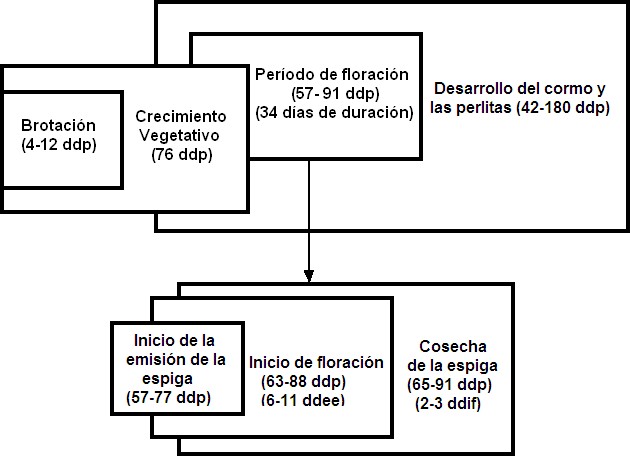
The knowledge of the phenology can apply appropriate and preventive practices, for efficient the production process and ensure the quality of the final product. This work has the objective to define the phenological phases in the crop of gladiolus. The investigation was carried out in field areas at “Liliana Dimitrova” Horticultural Research Institute during agricultural campaign 2008/2009 y 2009/2010. 10 plants per plot were selected during crop development to perform the following observations: emergency, vegetative growth, beginning emission the flower spikes (IEE--ddp days after planting), beginning of flowering (IF-days after the emission of spike-ddee), spike harvest (EC days after of beginning of flowering), flowering period and development of the corm and pearls. As a result we have the definition of four phenological phases in the variety of gladiolus 'Spic Span' during biological cicle of crop: Sprouting: 4-12 ddp, vegetative growth: 76 ddp, flowering period: 57-91 ddp, development of the corm and pearls: 42- 180 ddp.
Article Details

This work is licensed under a Creative Commons Attribution-NonCommercial 4.0 International License.
Those authors who have publications with this journal accept the following terms of the License Attribution-NonCommercial 4.0 International (CC BY-NC 4.0):
You are free to:
- Share — copy and redistribute the material in any medium or format
- Adapt — remix, transform, and build upon the material
The licensor cannot revoke these freedoms as long as you follow the license terms.
Under the following terms:
- Attribution — You must give appropriate credit, provide a link to the license, and indicate if changes were made. You may do so in any reasonable manner, but not in any way that suggests the licensor endorses you or your use.
- NonCommercial — You may not use the material for commercial purposes.
- No additional restrictions — You may not apply legal terms or technological measures that legally restrict others from doing anything the license permits.
The journal is not responsible for the opinions and concepts expressed in the works, they are the sole responsibility of the authors. The Editor, with the assistance of the Editorial Committee, reserves the right to suggest or request advisable or necessary modifications. They are accepted to publish original scientific papers, research results of interest that have not been published or sent to another journal for the same purpose.
The mention of trademarks of equipment, instruments or specific materials is for identification purposes, and there is no promotional commitment in relation to them, neither by the authors nor by the publisher.
How to Cite
References
Alfonso, C.A.; Otero, Lázara; Uriarte, Raquel y González, B. (2007): Estudio integral de los suelos del Instituto de Investigaciones Hortícolas “Liliana Dimitrova”. La Habana: Dirección Provincial de Suelos, 50 p.
Cea, Marjorie (2002): Caracterización de Gladiolos (Gladiolus grandiflorus) provenientes de semillas, para la obtención de líneas avanzadas adaptadas a las condiciones ambientales de la Novena Región. Tesis (Ingeniero Agrónomo). Temuco, Chile: Universidad Católica de Temuco. Escuela de Agronomía. 98 p.
Cisterna, María Valeska (2004): Evaluación del comportamiento agronómico de dos líneas avanzadas de gladiolos (Gladiolus grandiflorus) bajo diferentes condiciones edafoclimáticas del sur de Chile. Tesis Ingeniería Agropecuaria. Temuco, Chile: Universidad Católica de Temuco, 101 p.
Fernández, Alicia y Sotomayor, Elvis (2000): Etapas fenológicas del gladiolo (Gladiolus sp.): variedad Rosado. La Habana: Editora Liliana. 16p.
Fernández, M. Alicia; Marrero, G. Virginia; Salgado, P. Julia Mirta; Cruz, B. Mercedes; Igarza, S. A; Hernández, D. María Isabel; Calzada. V; Radme, Y. (2012): Recomendaciones técnicas para la producción y comercialización de flores de corte. La Habana: MINAG, 14 p.
García, L. M.; Gómez, A. JR.; Robles, B. A.; Díaz. H; García, V. RA. (2012): Efecto de la poda foliar postcosecha, en la producción de cormos de gladiolo. Revista fuente nueva época, México. vol. 4, no. 11, pp. 1 – 8. ISSN: 2007 – 0713.
González, P. E.; Yáñez, M. María de Jesús; Ortega, E. H M. (2009): Comparative analysis among pathogenic fungal species that cause gladiolus (Gladiolus grandiflorus Hort.) corm rot in Mexico. Revista Mexicana de Fitopatología, Texcoco, vol. 27, no. 1, pp. 45 – 52. ISSN: 2007-8080.
González, P. E.; Ayala, G. OJ; Carrillo, S. JA; García, S. G; Yáñez, M. María de Jesús; Juárez. M. (2011): Estudio del desarrollo, calidad de flor y dosis de fertilización en gladiolo (Gladiolus grandi- florus Hort.). Revista Fitotecnia Mexicana. Chapingo, vol. 34, no.4, pp. 277– 283. ISSN: 0187-7380.
Hernández, A.; Ascanio, M.O.; Morales, M. (1999): Nueva versión de clasificación genética de los suelos de Cuba. La Habana: Agrinfort, 64 p.
Hernández, D. María Isabel y Marrero, Virginia. (2006): Aportes al conocimiento de la fisiología del crecimiento, la nutrición y la fertilización en cuatro Especies de flores de corte para suelos ferralíticos. 23p.
INPROA (Instituto de Promoción Agraria). (2003): Manual No. 3 del cultivo de las flores. 130 p.
IUSS. (2008): Base referencial mundial del recurso suelo. Informe sobre recursos mundiales de suelo 164. Roma: FAO/ISRIC. 117p.
Rodríguez, M. (1997): Producción de gladiolos En: Producción de plantas ornamentales. Curso taller. Chile: Universidad Católica de Temuco. 64 p.
Rodríguez, J. F., Pinzor. H.; Leverde, H. (1998): Comportamiento del crecimiento y desarrollo del ajo (Allium sativum) c.v. Rosado Criollo. Agronomía Colombiana, Colombia, vol. 91, pp. 76 – 78.
Saldias, M. (1998): Manual de jardinería. Santiago Chile: Editorial Contrapunto, 226 p.
Streck, N. A., Bellé, R.A.; Backes, F.A.A.L.; Gabriel, L.F.; Uhlmann, L.O.; Becker, C.C. (2012): Desenvolvimento vegetativo e reprodutivo em gladíolo. Ciência Rural, Brasil, vol. 42, no. 11, pp. 1968-1974.
Verdugo, G. (1996): Producción de gladiolos bajo plástico. En: Curso flores para la Araucanía. Serie Carillanca Nº 50. 183p.