
Identification of tolerant varieties potato (Solanum tuberosum L.) to drought and high temperatures, by means of anatomic and physiological methods
Article Sidebar
Main Article Content
Abstract
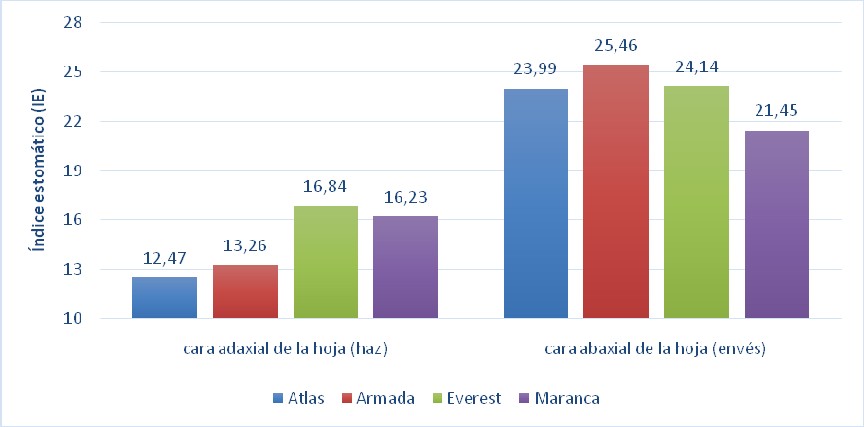
In the last 10 years, the areas dedicated to the potato in Cuba, decreased in a 58 % and the yield in a 21 % in that same period. To have tolerant varieties of potato to the drought and high temperatures is a factor key to increase the production and yield in conditions of stress, objective that we can obtained in a plant breeding program whit progenitors with anatomic and physiological characteristics related with the tolerance to drought and high temperatures. Experiments were developed at Research Institute of Tropical Root and Tuber Crops (INIVIT). Four varieties of potato were evaluated in farm conditions (Atlas, Armada, Everest and Maranca). Were determined the following index: Density and estomatic index, estomatic area, index of esclerofilia, degree of succulence and thermos- stability of the cell membrane. Atlas variety show the lower averages values of density estomatic 102.77 and 322.22 respectively. Esclerofilia's bigger index is in Atlas variety, with 49.65 mg/cm2, besides is the variety that minor relative percentage of damage evidenced to the cell membrane with: 0.4, 59 and 66.5 % to 40, 60 and 80 oC respectively.
Article Details

This work is licensed under a Creative Commons Attribution-NonCommercial 4.0 International License.
Those authors who have publications with this journal accept the following terms of the License Attribution-NonCommercial 4.0 International (CC BY-NC 4.0):
You are free to:
- Share — copy and redistribute the material in any medium or format
- Adapt — remix, transform, and build upon the material
The licensor cannot revoke these freedoms as long as you follow the license terms.
Under the following terms:
- Attribution — You must give appropriate credit, provide a link to the license, and indicate if changes were made. You may do so in any reasonable manner, but not in any way that suggests the licensor endorses you or your use.
- NonCommercial — You may not use the material for commercial purposes.
- No additional restrictions — You may not apply legal terms or technological measures that legally restrict others from doing anything the license permits.
The journal is not responsible for the opinions and concepts expressed in the works, they are the sole responsibility of the authors. The Editor, with the assistance of the Editorial Committee, reserves the right to suggest or request advisable or necessary modifications. They are accepted to publish original scientific papers, research results of interest that have not been published or sent to another journal for the same purpose.
The mention of trademarks of equipment, instruments or specific materials is for identification purposes, and there is no promotional commitment in relation to them, neither by the authors nor by the publisher.
How to Cite
References
Almadi, L. y Kowács L. (1986): The relationship between the transpiration and photosynthesis of xerophytic grasses abstracta botanic. Edit. Maszaros Draskowts, Rózsa and Kalopos. 10: 1-16.
Bajji, M., J.M. Kinet and S. Lutts. (2001). The use of the electrolyte leakage method for assessing cell membrane stability as a water stress tolerance test in durum wheat. Plant Growth Regulation, 00: 1-10.
Beltrano, J., Ronco, G. M. (2008). Improved tolerance of wheat plants (Triticum aestivum L.) to drought stress and rewatering by the arbuscular mycorrhizal fungus Glomus claroideum: Effect on growth and cell membrane stability. Braz. J. Plant Physiol., 20(1):29-37.
Gabriel, J., Porco, P., Angulo, A., Magne, J. La Torre,J., Mamani, P. (2011). Resistencia genética a estrés hídrico por sequía en variedades de papa (Solanum tuberosum L.) bajo invernadero. Revista Latinoamericana de la papa. Vol (16) 2:173-208.
Habibpor, M., Valizadeh, M., Shahbazi H., y Ahmadizadeh, M. (2011). Study of Drought Tolerance with Cell Membrane Stability Testing and Relation with the Drought Tolerance Indices in Genotypes of Wheat (Triticum aestivum L.). World Appl. Sci. J., 13 (7): 1654-1660.
Liu, J., Zhang, F., Zhou, J., Chen, F., Wang, B., Xie, X. (2012). Phytochrome B control of total leaf area and stomatal density affects drought tolerance in rice. PlantMol. Biol. 78: 289-300.
Prabha, D., Kumar, Y.N. (2014). Seed Treatment with Salicylic Acid Enhance Drought Tolerance in Capsicum World Journal of Agricultural Research. Vol. 2 (2): 42-46.
Sperdouli, I. y Moustakas, M. (2012). Interaction of proline, sugars and anthocyanins during photosynthetic acclimation of Arabidopsis thaliana to drought stress. J. Plant Physiol. 169,577– 585.
Wilkinson, H. (1979). The plant surface (mainly leaf). In: C.R. Metcalfe y Chalk (eds.). Anatomy of Dicotiledons. Oxford Claredous Press. London, 97-165.
Zarafshar, M., Akbarinia, M., Askari, H., Mohsen, S.H., Rahaie, M., Struve, D., Striker, G.G. (2014). Morphological, physiological and biochemical responses to soil water deficit in seedlings of three populations of wild pear tree (Pyrus boisseriana). Biotechnol. Agron. Soc. Environ. Vol. 18 (3):3