
Effect of mycorrhizae and biopesticides on cultivars of tropical root and tuber crops for suburban and family agriculture
Article Sidebar
Main Article Content
Abstract
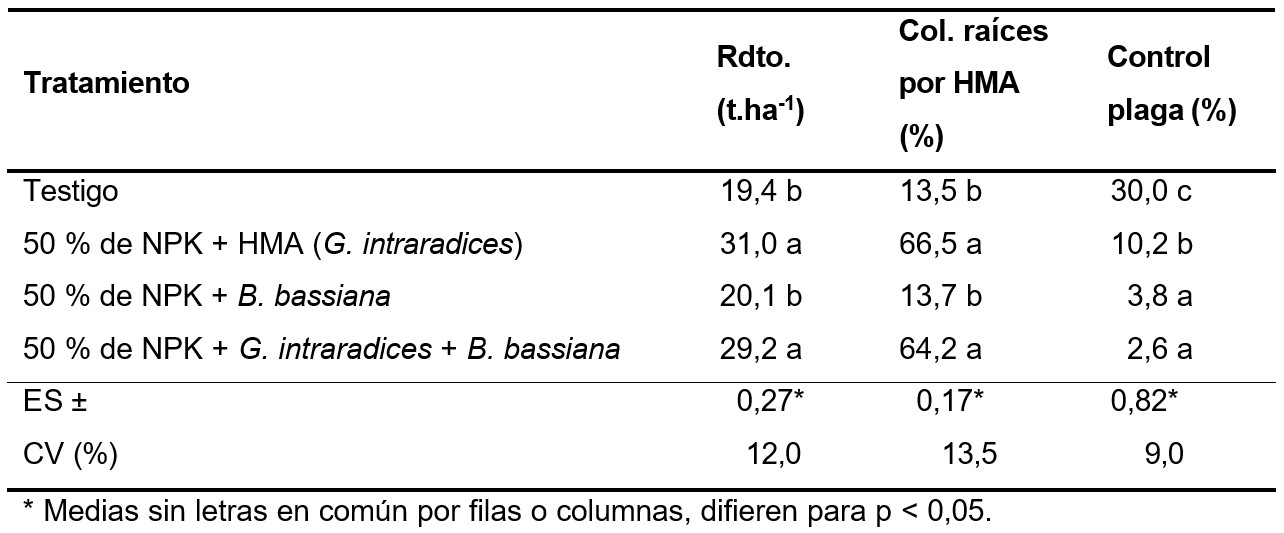
In order to determine the combined effect of mycorrhizae (EcoMic®) and biopesticides on yield and bio-protection against some pests and diseases in cassava, sweet potato, and aroids, a research was conducted at the Research Institute of Tropical Root and Tuber Crops (INIVIT) on a Carbonated soft brown soil of medium fertility. The commercial yield, the percentage of AMF colonization (G. intraradices) on crop roots and the effect on the incidence of pests and diseases were evaluated. The best treatments were 25 % NPK + G. intraradices + Bacillus thuringiensis in cassava with a commercial yield of 31,0 t.ha-1, 89,2 % of colonization of HMA and an efficiency of 91% of the product in the control of cassava hornworm (Erinnyis ello L); in sweet potato 50 % NPK + G. Intraradices + Beauveria bassiana with 29,2 t.ha-1, 64,2 % colonization and a decrease in the incidence of sweet potato weevil (Cylas formicarius F.) up to 2,6 %; and Xanthosoma 50 % NPK + G. intraradices + Trichoderma spp. with 33,8 t ha-1, an AMF colonization of 79,5 % and a low incidence of dry rot disease of 4,1 %. Effect of mycorrhizae and biopesticides on cultivars of tropical root and tuber crops for suburban and family agriculture.
Article Details

This work is licensed under a Creative Commons Attribution-NonCommercial 4.0 International License.
Those authors who have publications with this journal accept the following terms of the License Attribution-NonCommercial 4.0 International (CC BY-NC 4.0):
You are free to:
- Share — copy and redistribute the material in any medium or format
- Adapt — remix, transform, and build upon the material
The licensor cannot revoke these freedoms as long as you follow the license terms.
Under the following terms:
- Attribution — You must give appropriate credit, provide a link to the license, and indicate if changes were made. You may do so in any reasonable manner, but not in any way that suggests the licensor endorses you or your use.
- NonCommercial — You may not use the material for commercial purposes.
- No additional restrictions — You may not apply legal terms or technological measures that legally restrict others from doing anything the license permits.
The journal is not responsible for the opinions and concepts expressed in the works, they are the sole responsibility of the authors. The Editor, with the assistance of the Editorial Committee, reserves the right to suggest or request advisable or necessary modifications. They are accepted to publish original scientific papers, research results of interest that have not been published or sent to another journal for the same purpose.
The mention of trademarks of equipment, instruments or specific materials is for identification purposes, and there is no promotional commitment in relation to them, neither by the authors nor by the publisher.
How to Cite
References
Castellón, María del C.; A. Morales, Lilian Morales, N. Maza, Dania. Rodríguez, J Alcálzar, F. Cisneros. (2010). Componentes para el manejo Integrado del camote en: Manejo Integrado del Gorgojo del Camote o Tetuán del boniato, Cylas formicarius (Fab.), en Cuba. Fausto Cisneros y Jesús Alcanzar, eds. Centro Internacional de la Papa (CIP). Lima. Perú. 38 p.
Espinosa, E. (2013). Manejo agrotécnico del cultivo de la malanga (Xanthosoma sagittifolium (L.) Schott y Colocasia esculenta Schott) para el combate de las pudriciones secas. Tesis presentada en opción al grado científico de Doctor en Ciencias Agrícolas. Universidad Central “Marta Abreu” de Las Villas. Facultad de Ciencias Agropecuarias. 100 p.
Hernández, A.; J. M. Pérez Jiménez Y D. Bosch Infante y Y. L. Rivero. (1999). Nueva versión de la clasificación genética de los suelos de Cuba. Ciudad de La Habana: AGRINFOR.-- 64 p.
Lerch, G. (1977). La experimentación en las ciencias biológicas y agrícolas.-- La Habana: Ed. Científico Técnica.-- p. 302.
Phillips, D.M y Hayman, D.S. (1970). Improved procedures for clearing roots and staining parasitic and vesicular arbuscular mycorrhizal fungi for rapid assessment of infection. Trans. Br. Mycol. Soc., 55: 158-161.
Ruiz Martínez, L. (1995). Compatibilidad de las micorrizas VA con cuatro bioplaguicidas. Resúmenes de III Encuentro Nacional de Bioplaguicidas y EXPO-CREE.-- Ciudad de la Habana: INISAV.-- p. 75.
Ruiz Martínez, L. (2001). Efectividad de las asociaciones micorrízicas en especies vegetales de raíces y tubérculos en suelos Pardos mullidos carbonatados y Ferralíticos Rojos de la región central de Cuba. Tesis presentada en opción al grado científico de doctor en ciencias agrícolas.-- La Habana: INCA.-- 100 p.
Ruíz, L; J. Simo y R. Rivera. (2012). Las Micorrizas en cultivos tropicales. Una contribución a la sostenibilidad agroalimentaria. Editorial Académica Española, ISBN: 978-3-8484-5382-5, 239 p.
Stefanova, Marusia; Ileana Sandoval y Ana Fernández. (1995). Compatibilidad entre cepas de Trichoderma spp. y agentes bioplaguicidas, biofertilizantes y bioestimulantes. Memorias del III Encuentro Nacional Científico Técnico de Bioplaguicidas y EXPOCREE.-- Ciudad de la Habana: INISAV.-- p. 46.