
Chemical and nutritional characterization of it amends produced in the region de Guantánamo
Article Sidebar
Main Article Content
Abstract
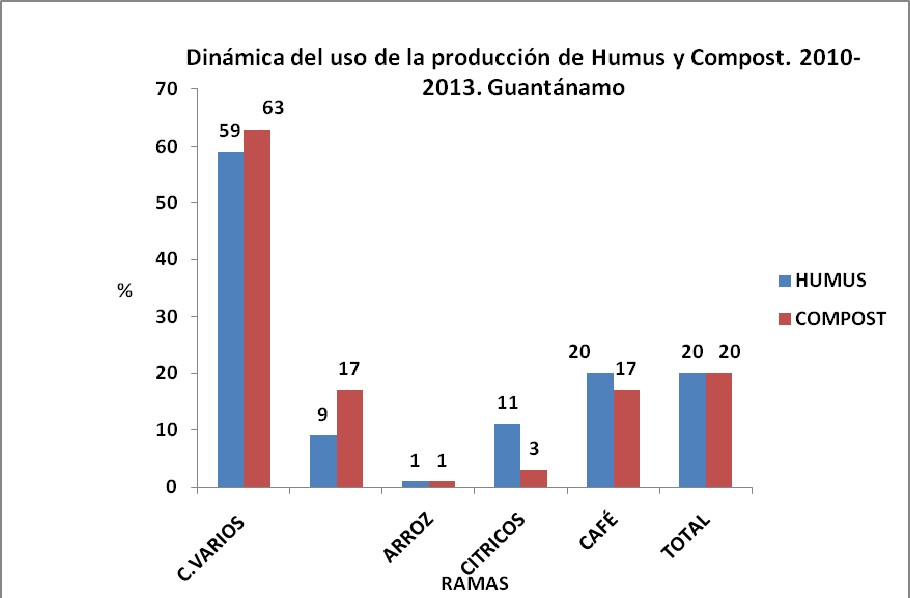
The present work was developed with the objective of evaluating the dynamics of the National production of the humus and compost in the agricultural sector of the Region of Guantánamo, for that which the inventories of the organic materials were characterized that you/they are used in the elaboration of the humus and the compost, as well as these products. The format Mapinfo version was used 11 to digitize the inventories of this County. The economic evaluation was made starting from contained NPK and its conversion in Urea, Superfosfato triple and Chloride of Potassium. They were determined in a case study, the impact of these products on the yields of the vegetables in the Region of Guantánamo. The obtained results demonstrate the effectiveness of these products in the yields and the economic analysis of the application of the humus and the compost they reflected favourable results with contributions in foreign currencies convertible average of more than 32 millions of annual CUC, favourable in the obtaining of earnings of the cabbage (181%), lettuce (122%), bean (228%), beet (109%), garlic (120. 151%), carrot (137%) and pepper (200%). At Regional level the production of the humus and compost left increasing per years, being more significant the corresponding to the compost, because different vegetables those were used which prevail in the studies of the inventories.
Article Details

This work is licensed under a Creative Commons Attribution-NonCommercial 4.0 International License.
Those authors who have publications with this journal accept the following terms of the License Attribution-NonCommercial 4.0 International (CC BY-NC 4.0):
You are free to:
- Share — copy and redistribute the material in any medium or format
- Adapt — remix, transform, and build upon the material
The licensor cannot revoke these freedoms as long as you follow the license terms.
Under the following terms:
- Attribution — You must give appropriate credit, provide a link to the license, and indicate if changes were made. You may do so in any reasonable manner, but not in any way that suggests the licensor endorses you or your use.
- NonCommercial — You may not use the material for commercial purposes.
- No additional restrictions — You may not apply legal terms or technological measures that legally restrict others from doing anything the license permits.
The journal is not responsible for the opinions and concepts expressed in the works, they are the sole responsibility of the authors. The Editor, with the assistance of the Editorial Committee, reserves the right to suggest or request advisable or necessary modifications. They are accepted to publish original scientific papers, research results of interest that have not been published or sent to another journal for the same purpose.
The mention of trademarks of equipment, instruments or specific materials is for identification purposes, and there is no promotional commitment in relation to them, neither by the authors nor by the publisher.
How to Cite
References
Arias, E. Martínez. F., Morales, A., García. C. (2008): Manual de Procedimiento de Abonos Orgánicos. ACTAF pp. 1- 27. La Habana.
Cairo. C. P. y O. Fundora (1994): Edafología. Ed. Pueblo y Educación. Ciudad de la Habana: 475 p.
Carrión, M. (1996): La agricultura urbana y el desarrollo rural sostenible. Seminario Taller Regional. FIDA/CIARA: 58(3) 110 – 118.
Castillo, A., E. Quarin., S.H., Iglesias (2000): Vermicompost chemical and physical characterization from raw and mixed organic Wastes. Agricultura Técnica 60: 74 – 79,
Díaz, E. (2004): La caracterización de sustratos .Memoria VI congreso iberoamericano para el desarrollo y aplicación en la agricultura (eds. CIDALPA 2004). Memorias, Santa Fé de Bogotá, pp 8 – 10,
Díaz, E, R. (2004b). La caracterización física de los sustratos. Memorias VI Congreso Iberoamericano para el desarrollo y Aplicación de plásticos en Agricultura. Acuña, J.F. y Medina, J.A. (eds. CIDALPA 2004). Memorias, Santa Fe de Bogotá, pp. 8 – 10, 2004.
Funes-Monzote, F. (2008).Fertilidad del suelo a largo plazo en sistemas biointensivos. LEISA. 24 (2): 9 –12.
García, C., Martínez, F y Cun (2013): Efecto del manejo de riego en el sistema de lombricultura sobre la calidad del humus de lombriz. En: Ciencias Ambientales Temáticas para el Desarrollo .Volumen VI. (Eds) 60-65 pag.
Gandarilla .J (1999): Uso del humus de lombriz en los principales suelos y cultivos de Cuba Trabajo presentado al CITMA en opción al premio anual según la resolución 24/ 98 Dirección Provincial de Suelos, pp: 16 – 22.
Martínez, F., Calero, B, Nogales, R., Revestí L. (2003): Lombricultura Manual Práctico Ciudad de La Habana, 100 pp. Eds. Calero, B. y Rovesto, L.
Morales, A. (2008): Efecto del empleo de residuales sólidos orgánicos convencionales y no convencionales en la población de Eisenia foetida durante el proceso de lombricultura. Tesis en Opción al Grado de Máster en Ciencias del Suelo. Universidad Agraria de la Habana, UNAH.
NC 51. (1999): Calidad del suelo. Análisis químico. Determinación del porciento de materia orgánica.
NC 52. (1999): Calidad del suelo. Determinación de las formas móviles de fosforo y potasio.
Peña, E., Carrión, M., Martínez, F., Rodríguez, A., Campanioni, N. (2004): Manual para la producción de abonos orgánicos en la agricultura urbana. Edición. INIFAT. pp 14- 58.
PNCMS (2001): Programa Nacional de Mejoramiento y Conservación de Suelos. Instituto de Suelos. AGROINFOR, Agencia de Información y Comunicación para la Agricultura. La Habana. 39 p.
Soto, G y Meléndez, G. (2003): Compost, abono o enmienda. ¿Cómo medir la calidad de un compost. En: G.Soto. y G. Menéndez (eds.) Taller de Abonos Orgánicos. San Pedro, Costa Rica, 15 p.
Soto, G. (2003): Abonos Orgánicos: El proceso de compostaje. En: G. Soto y G. Menéndez (eds.). Taller de Abonos Orgánicos. CATIE/ETZ/CIA/CANIAN/ San Pedro, Costa Rica, 27 p.
Vega .E, Rodríguez, R. y Serrano, N. (2006): Abonos orgánicos procesados como alternativa de sustratos en cultivos organopónicos e invernadero. Revista Naturaleza y Desarrollo 4(1): 24 -34.