
Biological regulation of plagues in the cultivation of the bean (Phaseolus vulgaris L.) in the province of Ciego of Avila, Cuba
Article Sidebar
Main Article Content
Abstract
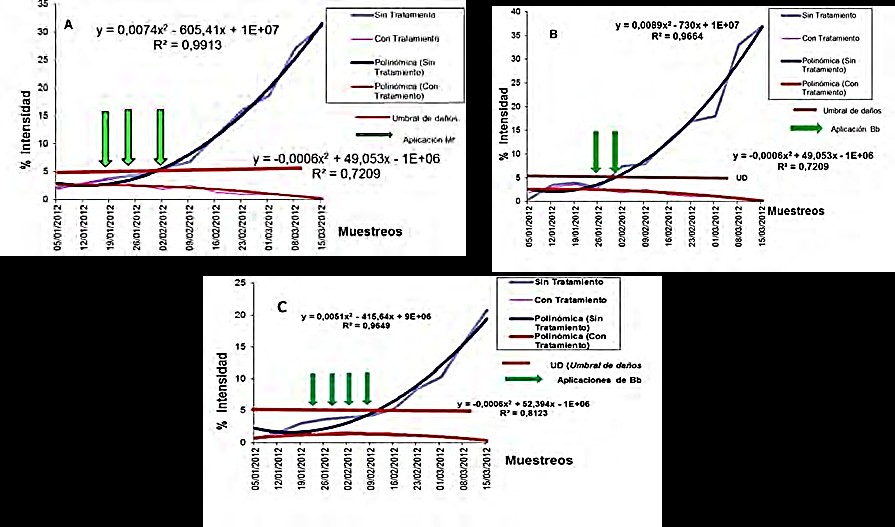
The essay was carried out with de objective of determining the key plagues and their regulation with biological pesticides in the cultivation of the bean, in the province of Ciego of Ávila. The effects of the boundary to analyze their possible consequence in the appearance of the insects, and the incidence and distribution of the noxious organisms were determined. The technical effectiveness and the virulence of the biological alternatives applied, as well as the economic valuation were also evaluated. An analysis of simple variance was applied with the test of multiple ranges of Duncan with 5% of error probability for the comparison of the average values. It was carried out the adjustment of the polynomial equation and the calculation of the coefficient of determination. A statistical package SSPS version 17 was used. The incidence of the plagues was not determined by the effect of the boundary. The values of the intensity and distribution in the treatments were: Empoasca kraemeri 2,6% and 16%; Diabrotica balteata 2,6% and 5%; Andrector ruficornis 1,6% and 18%. The technical effectiveness of Metarhizium anisopliae in the regulation of Empoasca kraemeri was 88%, while technical effectiveness of Beauveria bassiana in the regulation of Diabrotica balteata and Andrector ruficornis was 76%. It is economically justified the biological alternative for the regulation of the pests in the cultivation of the bean, with a relationship benefit/cost equal to 1, 2.
Article Details

This work is licensed under a Creative Commons Attribution-NonCommercial 4.0 International License.
Those authors who have publications with this journal accept the following terms of the License Attribution-NonCommercial 4.0 International (CC BY-NC 4.0):
You are free to:
- Share — copy and redistribute the material in any medium or format
- Adapt — remix, transform, and build upon the material
The licensor cannot revoke these freedoms as long as you follow the license terms.
Under the following terms:
- Attribution — You must give appropriate credit, provide a link to the license, and indicate if changes were made. You may do so in any reasonable manner, but not in any way that suggests the licensor endorses you or your use.
- NonCommercial — You may not use the material for commercial purposes.
- No additional restrictions — You may not apply legal terms or technological measures that legally restrict others from doing anything the license permits.
The journal is not responsible for the opinions and concepts expressed in the works, they are the sole responsibility of the authors. The Editor, with the assistance of the Editorial Committee, reserves the right to suggest or request advisable or necessary modifications. They are accepted to publish original scientific papers, research results of interest that have not been published or sent to another journal for the same purpose.
The mention of trademarks of equipment, instruments or specific materials is for identification purposes, and there is no promotional commitment in relation to them, neither by the authors nor by the publisher.
How to Cite
References
CNSV (2010). Centro Nacional de Sanidad Vegetal. Metodologías de señalización.
FAO (2010). Organización de las Naciones Unidas para la Agricultura y la Alimentación. Dirección de Estadística.
FAOSTAT (2010). Dirección de Estadística.
FAOSTAT (2010). Top importaciones de Frijoles Secos del año 2007. FAO Dirección de Estadística.
FAO (2011) ¿Qué es la agricultura orgánica? [en línea]. http://www.fao.org/docrep/007/ad8 18s/ad818s03.htm Consultado: 15/03/13.
Instructivo Técnico (2011). Cultivo del Frijol (Phaseolus vulgaris L.).
Sambrano et al. (2008). Procedimiento para la preparación de hongos entomopatógenos. Perú.
Martínez, E. G, Barrios. L, Rovesti. R. Santos (2007). Manual Práctico Manejo Integrado de Plagas pág. 189.
Rodríguez Álvarez Yander (2012). Regulación biológica de Diabrotica balteata Le Conte en el cultivo del frijol. Tesis de grado para opción de Ingeniero Agrónomo.
Vázquez, L.L., Y .Matienzo, M. Veitia y J. Alfonso (2008). Manejo y Conservación de enemigos naturales de insectos fitófagos en los sistemas agrícolas de Cuba. Ed. CIDISAV ISBN: 978-959- 7194-17-0.202 p.