
Effect of the Canavalia ensiformis (L.) inoculated with arbuscular mycorrhizal fungi (AHM) in the improvement of indicators of the soils
Article Sidebar
Main Article Content
Abstract
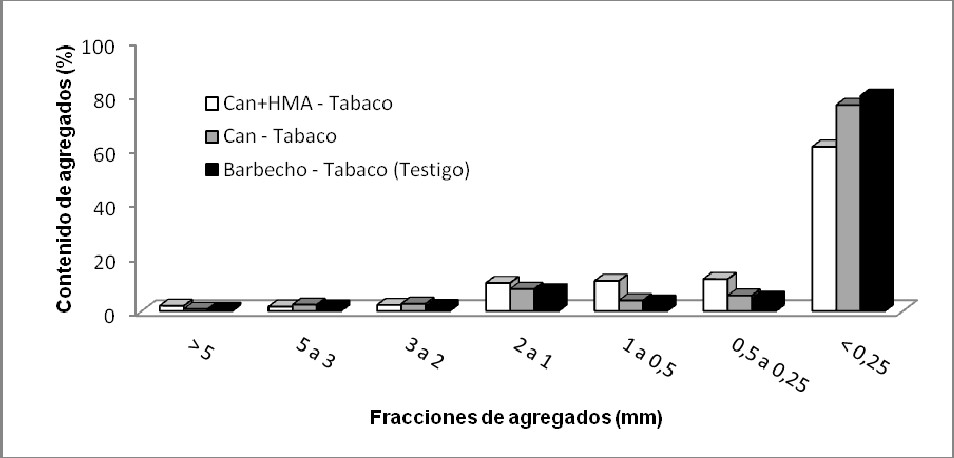
The soils in the city San Juan y Martinez possess a progressive loss of fertility and of chemical, physical and biological properties, due to the intense laborer and the time of exhibition to erosive factors, for what has become necessary the application of technologies that you minimize the deterioration of the soil and allow the restitution of the lost fertility. With the aim to evaluate the influence of the Canavalia ensiformis, L. inoculated with HMA as green manure for improvement of the indicators of quality of a soil Ferralítico Cuarcítico Amarillo lixiviado, it was carried out an experiment that it includes the handling of the canavalia inoculated with HMA, canavalia without inoculating and the witness conformed by fallow. The results demonstrate that the use of the C. ensiformis (L.) inoculated with incorporate HMA to the soil like green manure improves the quality of the soils, in indicators as basaltic breathing, total content of organic matter and the distribution of the aggregates from the resistant soil to the water.
Article Details

This work is licensed under a Creative Commons Attribution-NonCommercial 4.0 International License.
Those authors who have publications with this journal accept the following terms of the License Attribution-NonCommercial 4.0 International (CC BY-NC 4.0):
You are free to:
- Share — copy and redistribute the material in any medium or format
- Adapt — remix, transform, and build upon the material
The licensor cannot revoke these freedoms as long as you follow the license terms.
Under the following terms:
- Attribution — You must give appropriate credit, provide a link to the license, and indicate if changes were made. You may do so in any reasonable manner, but not in any way that suggests the licensor endorses you or your use.
- NonCommercial — You may not use the material for commercial purposes.
- No additional restrictions — You may not apply legal terms or technological measures that legally restrict others from doing anything the license permits.
The journal is not responsible for the opinions and concepts expressed in the works, they are the sole responsibility of the authors. The Editor, with the assistance of the Editorial Committee, reserves the right to suggest or request advisable or necessary modifications. They are accepted to publish original scientific papers, research results of interest that have not been published or sent to another journal for the same purpose.
The mention of trademarks of equipment, instruments or specific materials is for identification purposes, and there is no promotional commitment in relation to them, neither by the authors nor by the publisher.
How to Cite
References
Barrios, E.; Mahuku, G.; Avia, J.; Cortés, L.; Asakawa, N.; Jara, C and Quintero, J. 2006. Green manure impact on nematodes, arbuscular mycorrhizal and pathogenic fungi in Tropical Soils planted to common beans. 167 – 190. En: 18th World Congress of Soil Science. Philadelphia, Pennsylvania, USA. 9 July 2006.
Bouza, H.; Herrera, L.M.; Torres, C.; Iznaga, E y Vladimirov, V.E. 1981. Utilización de la labranza mínima en los suelos tabacaleros de la provincia de Pinar del Río. Ciencias de la Agricultura. 1981. Vol. 10,p. 83–102.
Bronick, C.J. and Lal, R. 2005. Soil structure and management: a review. Geoderma. 2005. Vol. 124, no. 1, p. 3–22.
Daynes, C.N.; Field, D.J.; Saleeba, Jennifer A.; Cole, M.A. and Mcgee, P.A. 2013. Development and stabilisation of soil structure via interactions between organic matter, arbuscular mycorrhizal fungi and plant roots. Soil Biology and Biochemistry. 2013. Vol. 57, no. 0, p. 683–694. DOI http://dx.doi.org/10.1016/j.soilbio. 2012.09.020.
Dommerguez, Y. 1960. La notion de coefficient de mineralization du carbone dans les sols. Un example d’utilization des tecniques biologiques. Agron. Trop. 1960. Vol. 1, no. 1, p. 54–60.
Filho, P.F.M. 2004. Potencial de rehabilitação do solo de uma área degradada, através da revegetação e do manejo microbiano. Piracicaba, São Paulo: Escola Superior de Agricultura Liuz de Queiroz.
Forster, J.C. 1995. Soil physical analysis. Determination of the gravimetric water content and soil dry mass. In: Methods in applied soil microbiology and biochemistry. Ed. Kassem Alef and Paolo Nannipieri. London.
González, Yarilis L.; Martínez, J.M.; Miliáns, J.G.G. y Rubido, Milagros.G. 2009. Influencia de la alternancia de cultivos en la actividad microbiológica de un suelo tabacalero de pinar del río. CUBATABACO. 10, 1, p. 37–41.
Hernández, A.; Pérez, J.M.; Bosh, D y Rivero, L. 1999. Nueva versión de clasificación genética de los suelos de Cuba. Ed. Inst. de Suelos. C. de la Habana: AGRINFOR. p.64
Isemeyer, H. 1952. Eine einfache Methode zur Bestimmung der Bodenatmung und der Karbonate im Boden. In: Methods in Applied Soil Microbiology and Biochemistry. Kassem Alef and Paolo Nannipieri, (eds.) Acad.Press.Chapter,5.
Kuzyakov, Y. 2006. Root and rhizomicrobial respiration: a review of approaches to estimate respiration by autotrophic and heterotrophic organisms in soil. 2006. Vol. 38, p. 425–448.
Martínez, R.; López, Marisol.; Dibut, B.; Zambrano, Carmen. P. y Sánchez, Janet R. 2007. La fijación biológica del nitrógeno atmosférico en condiciones tropicales. 2007. P. 172p.
Morell, F.; Hernández, A.; Borges, Yenia y Marentes, F.L. 2009. La actividad de los hongos micorrízicos arbusculares en la estructura del suelo. Cultivos Tropicales. 2009. Vol. 30, no. 4, p. 00–00.
Nannimpieri, P.; Grego, S. and Ceccanti, B. 1990. Ecological significance of the biological activity in soil.In: Bollag J.M.,Stotzky, G. (Eds.), Soil Biochemistry. Vol. 6.: 293 – 355.
Orellana, Rosa G.; Moreno, J.M.; Cruz, A.; Onelia, Maria.; Díaz, Maritza. y Martorell, Ana. 2004. Procedimientos e Indicadores Físicos para la Evaluación de Suelos y Sustratos Orgánicos. Encuentro Internacional de Agricultura Urbana, AGRONAT’ 2004. Presentado en el Concurso Nacional de Agricultura Urbana. Publicado en la Red URBES.
Pandey, R.R.; Sharma, G.; Singh, T.B. and Tripathi, S.K. 2010. Factors influencing soil CO2 efflux in a northeastern Indian oak forest and plantation. African Journal of Plant Science, 4 (8): 280 – 289.
Peng, S.; Shen, H.; Yuan, J.; Wei, C. and Guo, T. 2011. Impacts of arbuscular mycorrhizal fungi on soil aggregation dynamics of neutral purple soil. Shengtai Xuebao/ Acta Ecologica Sinica. 2011. Vol. 31, no. 2, p. 498–505.
Peña, L.C. 2001. La agroindustria tabacalera cubana en la decada de los noventa y su inserción en la economía internacional. In: XXIII Congreso Internacional de LASA [online]. Marriott Wardman Park Hotel, Washington DC: Centro de Investigación de la Economía Internacional, Univ. La Habana. 6 September 2001. p. 29. Available from: http://www.nodo50.org/ cubasigloXXI/economia/castellanos1_300603.p
Rodríguez, P. 2010. Compendio sobre microbiología agrícola. Univ. de Oriente : Dpto Agropecuario.
Salamanca, W.F.; Bonilla, C.R. y Sánchez, M.S. 2004. Evaluación de seis abonos verdes en un vertisol ústico en condiciones del Valle del Cauca. Acta Agronómica. 2004. Vol. 3, no. 4, p. 53.
Sampaio, M.; de Polli, H.; de Aquino, Adriana María.; Fernandes, María E. and Costa, Janaina. 2011.
Bioindicators of soil quality in coffee organic cultivation systems. Pesquisa Agropecuaria Brasileira. May 2011. Vol. 46, no. 5.
Singh, P.K. 2012. Role of glomalin related soil protein produced by arbuscular mycorrhizal fungi: a review. 2012. p. 119–125.
Valenti, F.P.; Peña, J.L. y Morales, T.C. 1988. Efecto de diferentes cultivos antecesores en la producción tabacalera y en la economía empresarial. CIENCIAS DE LA AGRICULTURA. 33.
Vasconcellos, R.L.F.; Bonfim, J.A.; Baretta, D. and Cardoso, E.J.B.N. 2013. Arbuscular Mycorrhizal Fungi and Glomalin-Related Soil Protein as Potential Indicators of Soil Quality in a Recuperation Gradient of the Atlantic Forest in Brazil. Land Degradation & Development. 2013. P. n/a–n/a. DOI 10.1002/ldr.2228.
Videla, C.; Pazos, A.; Trivelin, P.C.; Echeverría, H.E. y Studdert, G.A. 2005. Mineralización bruta de nitrógeno bajo labranza convencional, siembra directa y pastura. Ciencias del Suelo. 2005. Vol. 23, no. 2.
Walkley, A. and Black, I.A. 1934. A examination of the Degtjareff method for determining soil organic matter and preposed modification of the chromic acid tritation method. Soil Science. 1934. Vol. 37, p. 29–38.