
Test of three planting distance in the seed production of Queen Margarita (Callistephus sinensis)
Article Sidebar
Main Article Content
Abstract
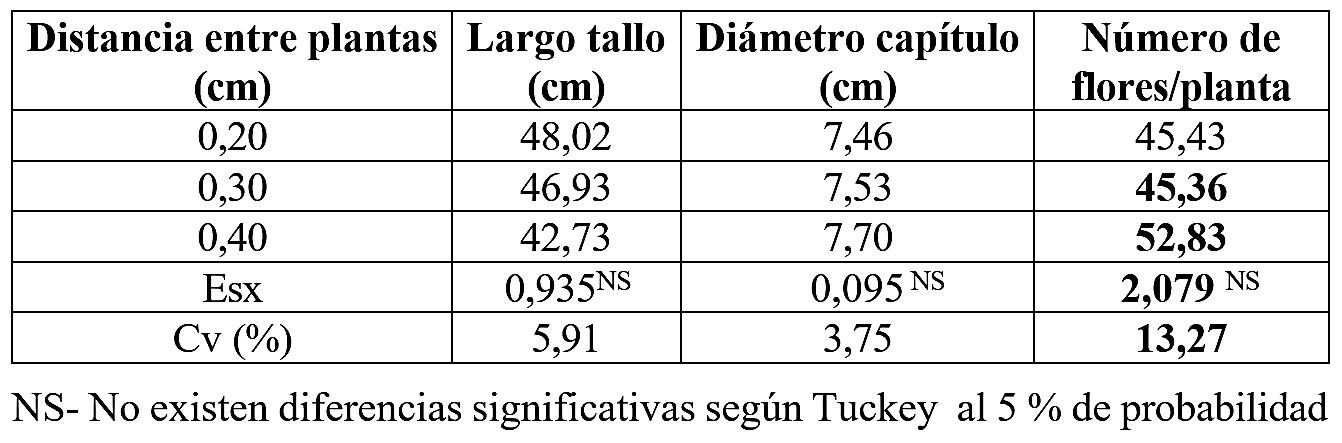
One of the main problems of the agricultural production is the right setting up of the plant population in the field. The objective of this study was to determine the influence exerted by the planting distance on the yield and the seed quality in the cultivation of Queen Margarita. This experiment was carried out in the 2002 - 2004 campaign at the “Liliana Dimitrova Horticulture Research Institute” on a tipical red ferralitic soil using the following planting distances: (0,90 x 0,20) m; (0,90 x 0,30) m and (0,90 x 0,40) m. The results showed that there was no significant difference due to the plant density in any of the evaluated variables; however, the more the plant density was set, the more the flower stalk length was got. It did not occur in that way in the cases of the capitulum diameter and the number of flowers per plant, because its better behaviours are achieved when the plant density is smaller (higher distances between plants). The planting distance (0,90 x 0,30) m exerted a marked effect on the seed number, seed per plant yield as well as the germination percentage. The weight of 1000 seed was affected when the planting distance was reduced.
Article Details

This work is licensed under a Creative Commons Attribution-NonCommercial 4.0 International License.
Those authors who have publications with this journal accept the following terms of the License Attribution-NonCommercial 4.0 International (CC BY-NC 4.0):
You are free to:
- Share — copy and redistribute the material in any medium or format
- Adapt — remix, transform, and build upon the material
The licensor cannot revoke these freedoms as long as you follow the license terms.
Under the following terms:
- Attribution — You must give appropriate credit, provide a link to the license, and indicate if changes were made. You may do so in any reasonable manner, but not in any way that suggests the licensor endorses you or your use.
- NonCommercial — You may not use the material for commercial purposes.
- No additional restrictions — You may not apply legal terms or technological measures that legally restrict others from doing anything the license permits.
The journal is not responsible for the opinions and concepts expressed in the works, they are the sole responsibility of the authors. The Editor, with the assistance of the Editorial Committee, reserves the right to suggest or request advisable or necessary modifications. They are accepted to publish original scientific papers, research results of interest that have not been published or sent to another journal for the same purpose.
The mention of trademarks of equipment, instruments or specific materials is for identification purposes, and there is no promotional commitment in relation to them, neither by the authors nor by the publisher.
How to Cite
References
Álvarez Pinto, M. (1980). Floricultura. Ed. Pueblo y Educación. C Habana, 828 p.
Delouche, J. C. (2005). Calidad y desempeño de la semilla, [en línea]. Revista Seed News. Dirección URL:<http://www.seednewws.inf.br/espanhol/seed95/artigocapa95- esp.shtml> [Consulta: 22 abril 2012].
Ecured, (2011). La floricultura, [en línea]. Dirección URL: <http://www.ecured.cu/index.php/Floricultura>. [Consulta: 22 abril 2012].
Fernández, A., Marrero, V., Salgado, J. M.; Cruz, M., Igarza, A.; Hernández, M. I., Calzada, V.; Rajme, Y. (2010). Recomendaciones técnicas para la producción y comercialización de flores de corte. La Habana: Instituto de Investigaciones Hortícolas Liliana Dimitrova, Cuba, 21 p.
Grabowska, B. (1980). Effect of planting density on flowering and quality of gladiolus W. Kopernik grownunder plastic. Instituto sadowhicta and kwisiartwa, 49-54.
Hadler Hasse, (2004). Tecnología de siembra: Cuidados y desafíos. Revista Seed News. Dirección URL: http://www.seednews.inf.br/espanhol/seed83/artigocapa83a_esp.shtml. [Consulta: 30 mayol 2012].
Hernández, A.; Ascanio, M.O.; Morales, M. (2000): Nueva versión de clasificación genética de los suelos de Cuba. La Habana: Minag, 26p.
ISTA. (1977). Reglas Internacionales para ensayos de semillas: Instituto Nacional de Semillas y Plantas de Vivero; Ministerio de la Agricultura: Madrid. España, 184 p.
Ramírez, A, R. Plana, Irene Moreno. (2001). Efectos de la tecnología de siembra sobre el cultivo del trigo en condiciones tropicales. Cultivos Tropicales, 22 (2): 15-19.
Sigarroa, A. (1985). Biometría y diseño experimental. Ed. Pueblo y Educación, La Habana, 374 p.