
Study of root systems of sugarcane genotyps on differents soils
Article Sidebar
Main Article Content
Abstract
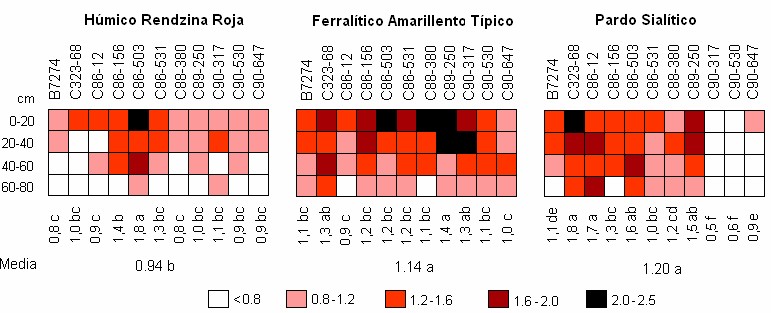
The objective of the present work was to study the density and distribution of sugarcane root systems in a multi-environment trial. Experiments were conducted at three soils in the South-Eastern region of Cuba, with 11 sugarcane cultivars. Measurements of root diameter and root density (root numbers/cm3) for fine (FD), thick (ThD) and total (TD) roots were taken using the profile wall method. The root system was evaluated in squares of 20 x 100 cm up to 80 cm depth below the ground surface. Cane yield data (t/ha) and its relations with root system measurements were analysed. Genotype by environment interaction was identified using the AMMI model. Results showed significant (p<0.05) response for root density across genotypes, soils, depths and all interactions. Root depth was the major source of variation. Percentage of total root density was variable from 42.6-55.5% for 0- 20 cm depth, dropping to 5.6-11.7% for 60-80 cm depth. Genotypes C86-12, C86-156, B7274 and C88-380 showed similar patterns for t/ha and TD. Moderate but significant (p<0.01) correlations were found between t/ha and FD, ThD and TD.
Article Details

This work is licensed under a Creative Commons Attribution-NonCommercial 4.0 International License.
Those authors who have publications with this journal accept the following terms of the License Attribution-NonCommercial 4.0 International (CC BY-NC 4.0):
You are free to:
- Share — copy and redistribute the material in any medium or format
- Adapt — remix, transform, and build upon the material
The licensor cannot revoke these freedoms as long as you follow the license terms.
Under the following terms:
- Attribution — You must give appropriate credit, provide a link to the license, and indicate if changes were made. You may do so in any reasonable manner, but not in any way that suggests the licensor endorses you or your use.
- NonCommercial — You may not use the material for commercial purposes.
- No additional restrictions — You may not apply legal terms or technological measures that legally restrict others from doing anything the license permits.
The journal is not responsible for the opinions and concepts expressed in the works, they are the sole responsibility of the authors. The Editor, with the assistance of the Editorial Committee, reserves the right to suggest or request advisable or necessary modifications. They are accepted to publish original scientific papers, research results of interest that have not been published or sent to another journal for the same purpose.
The mention of trademarks of equipment, instruments or specific materials is for identification purposes, and there is no promotional commitment in relation to them, neither by the authors nor by the publisher.
How to Cite
References
Alvarez, I.A.; Camargo, P.R.; Stolf Nogueira, M.C. (2000): Crescimento de raízes de cana crua e queimada em dois ciclos. Scientia Agricola, v.57, n.4, p.653-659.
Ball-Coelho, B.; Sampaio, E.V.S.B.; Tiessen, H.; Stewart, J.W.B. (1992): Root dynamic in plant ratoon crops of sugar cane. Plant and Soil, 142: 97-305.
Clark, L.J.; Whalley, W.R.; and Barraclough, P.B. (2003): How do roots penetrate strong soil?. Plant and Soil 255: 93–104.
Dillewijn, C. Van. (1952): Botany of Sugarcane, Chronica Botanica Co., Waltham, Mass
Hernández, A; Pérez, J.M; Bosch, D. y Rivero, L. (1999): Nueva Versión de Clasificación Genética de los Suelos de Cuba. AGRINFOR, 64 pp.
Landell, M.G.A.; Campana, M.P.; Figueiredo, P.; Vasconcelos, A.C.M.; Xavier, M.A.; Bidoia, M.A.; Prado, H.; Silva, M.A.; Dinardo-Miranda, L.L.; Santos A.S.; Perecin D.; Rossetto, R.; Martin, A.L.; Gallo, P.B. y Souza, S.C. (2005): Variedades de cana-de-açúcar para o centro-sur do Brasil. 15ª Liberação do programa cana IAC (1995-2005). Campinas: Instituto Agronômico. 17p (Boletim Técnico; 197).
Leyva, O. S.; Figueredo A. A.; Parra L.S. y Arcia T.B. (2000): Laboreo mínimo y desarrollo del sistema radical en caña de azúcar. Rev. ATAC No. 1. pp 44-47.
Gauch H. G., Hans-Peter P., y Annicchiarico P. (2008): Statistical Analysis of Yield Trials by AMMI and GGE: Further Considerations. Crop Sci. 48:866–889.
Jorge, H.; R. González, M. Casas e Ibis Jorge. (2002): Normas y Procedimientos del Programa de Mejoramiento Genético de la Caña de Azúcar en Cuba. Boletín No. 1 Cuba&Caña. INICA. 308p.
Martin O. J. R. (1987): La caña de azúcar en Cuba. D. Científico-Técnica. La Habana. 16-32 pp.
Roldós J. O. (1986): Evaluación de algunos factores edáficos limitantes de la producción de la caña de azúcar. Tesis presentada en opción al grado de científico de Doctor en Ciencias Agrícolas. La Habana. 50-70 pp.
Sakaigaichi T., Y. Terajima, A. Sugimoto, S. Irei, S. Fukuhara, M. Matsuoka, K. Ujihara, J. Abe and R. Tarima. (2007): Comparison of root distribution and root growth direction in two sugarcane hybrids with contrasting tolerance to water stress. Proc. Int. Soc. Sugar Cane Technol., Vol.
754-757 pp.
Sampaio, E.V.S.B.; Salcedo, J.H. y Cavalcanti, F.J.A. (1987): Dinâmica de nutrientes em cana-de- açúcar: III. Conteúdo de nutrientes e distribuição do sistema radicular no solo. Pesquisa Agropecuária Brasileira, v.22, p.425-431
Smith, D.M.; Inman-Bamber, N.G. and Thorburn, P. J. (2005): Growth and function of the sugarcane root system. Field Crops Res., 92: 169–183.
Vasconcelos, A.C.M. (2002): Desenvolvimento do sistema radicular e da parte aérea de socas de cana-de-açúcar sob dois sistemas de colheita: crua mecanizada e queimada manual. Jaboticabal: UNESP/FCAV, 140p.(Tese - Doutorado).
Vasconcelos, A.C.M.; Casagrande, A.A.; Perecin, D.; Jorge, L.A.C.; Landell, M.G.A. (2003): Avaliação do sistema radicular de cana-de-açúcar por diferentes métodos. Revista Brasileira de Ciência do Solo, v.27, p.849-858.