
Socialización del cultivo del trigo en Cuba: antecedentes y actualidad
Article Sidebar
Main Article Content
Abstract
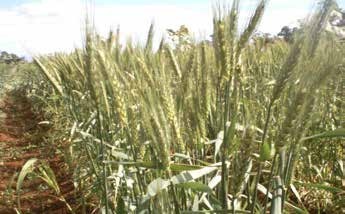
El trigo es símbolo de alimento en todo el mundo. Fue introducido en Cuba con la conquista española. Se cultivó con bastante éxito, hasta principios del siglo XIX, época en la que se abandonó casi totalmente, dado por lo floreciente que resultaba el cultivo del tabaco y la caña de azúcar. Desde hace más de un siglo la Estación Experimental Agronómica de Santiago de las Vegas (actualmente Instituto de Investigaciones Fundamentales en Agricultura Tropical “Alejandro de Humboldt”, INIFAT), ha desarrollado investigaciones para la reintroducción de este cultivo en el país. En el trabajo se recogen antecedentes históricos del cultivo del trigo en Cuba, algunos aspectos acerca de las características de las variedades existentes y de la labor extensionista y divulgativa para garantizar la apropiación del cultivo del trigo por parte de diferentes actores. Así como experiencias más significativas detectadas en su introducción en la provincia de Sancti Spíritus.
Article Details

This work is licensed under a Creative Commons Attribution-NonCommercial 4.0 International License.
Those authors who have publications with this journal accept the following terms of the License Attribution-NonCommercial 4.0 International (CC BY-NC 4.0):
You are free to:
- Share — copy and redistribute the material in any medium or format
- Adapt — remix, transform, and build upon the material
The licensor cannot revoke these freedoms as long as you follow the license terms.
Under the following terms:
- Attribution — You must give appropriate credit, provide a link to the license, and indicate if changes were made. You may do so in any reasonable manner, but not in any way that suggests the licensor endorses you or your use.
- NonCommercial — You may not use the material for commercial purposes.
- No additional restrictions — You may not apply legal terms or technological measures that legally restrict others from doing anything the license permits.
The journal is not responsible for the opinions and concepts expressed in the works, they are the sole responsibility of the authors. The Editor, with the assistance of the Editorial Committee, reserves the right to suggest or request advisable or necessary modifications. They are accepted to publish original scientific papers, research results of interest that have not been published or sent to another journal for the same purpose.
The mention of trademarks of equipment, instruments or specific materials is for identification purposes, and there is no promotional commitment in relation to them, neither by the authors nor by the publisher.
How to Cite
References
Bachiller y Morales, A, (1848): Cultivo del trigo en Cuba. Memoria de la Real Sociedad Económica de La Habana, T 36.
Castiñeiras García, R. (2004): Calidad de vida y desarrollo social en Cuba. Cuba Socialista No. 30.
De Souza Silva, J. y colectivo de autores. (2005): La innovación de la innovación institucional. ISBN-9978-44-632-X.
Informe del Subprograma, Legajos sobre trigo. Archivos INIFAT, 1965.
Lage, A. (2007): Propiedad en la economía del conocimiento. firgoa.usc.es/drupal/taxonomy/term.
Misas Jiménez, R. (1993): El trigo en Cuba. Primera mitad del siglo XIX. Editorial Académica. La Habana. 127 pp.
Pérez Talavera, S. (en prensa): Libro Radiobiología y Radiomutagénesis Vegetal. 160 p. Editorial EYPASA. Madrid.
Zerquera y Fernández de Lara, C. J., Montes de Oca Viciedo, L. (1998): Primeras producciones agrícolas en Trinidad y el Valle de los Ingenios. Siga la Marcha 11: 27-34