
Contribution of the Central Genebank of Cuba to development the agrifood systems
Article Sidebar
Main Article Content
Abstract
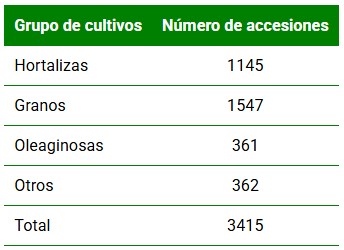
The Central Germplasm Bank of Cuba (BCGC) is tasked with safeguarding the base and duplicate germplasm collections from the Centers that make up the National Plant Genetic Resources System. The aim of this study is to assess how the BCGC has contributed to the development of agricultural systems and to analyze the need to strengthen and recognize its role in achieving sustainable food systems. Data were collected from the monitoring of Plant Genetic Resources for Food and Agriculture in Cuba during the period 2012-2023, and were divided into three stages to organize and analyze the information. Key findings show that the BCGC holds approximately 3,500 accessions representing more than 340 species. Of these, 90% are preserved as seeds, 9.7% in field collections, and 0.3% in vitro. Notably, 65% of the conserved accessions are Cuban in origin, which adds significant value to the preserved germplasm and makes it an attractive resource for regional and global projects and initiatives. The BCGC has helped address national challenges by providing various vegetable, grain, and oilseed varieties, as reflected in the catalog of cultivars developed by INIFAT, which includes 142 cultivars from 46 botanical species. Its richness and diversity demonstrate real potential for developing new varieties that meet the demands of the country's food systems.
Article Details

This work is licensed under a Creative Commons Attribution-NonCommercial 4.0 International License.
Those authors who have publications with this journal accept the following terms of the License Attribution-NonCommercial 4.0 International (CC BY-NC 4.0):
You are free to:
- Share — copy and redistribute the material in any medium or format
- Adapt — remix, transform, and build upon the material
The licensor cannot revoke these freedoms as long as you follow the license terms.
Under the following terms:
- Attribution — You must give appropriate credit, provide a link to the license, and indicate if changes were made. You may do so in any reasonable manner, but not in any way that suggests the licensor endorses you or your use.
- NonCommercial — You may not use the material for commercial purposes.
- No additional restrictions — You may not apply legal terms or technological measures that legally restrict others from doing anything the license permits.
The journal is not responsible for the opinions and concepts expressed in the works, they are the sole responsibility of the authors. The Editor, with the assistance of the Editorial Committee, reserves the right to suggest or request advisable or necessary modifications. They are accepted to publish original scientific papers, research results of interest that have not been published or sent to another journal for the same purpose.
The mention of trademarks of equipment, instruments or specific materials is for identification purposes, and there is no promotional commitment in relation to them, neither by the authors nor by the publisher.
How to Cite
References
Argumedo, A., Bahloul, Y., Crane, P., Mapusua, K., McCouch, S., Nnadozie, K., Schmitz, S., Ubalijoro, E., Vermeulen, S. y Wopereis, M. (2023). Empowering genebanks to transform agrifood systems (6 p.). Crops Trust. Disponible en: www.crop.trust/
Bello, R., Companioni, N., Peña, E., Ortiz, L. y Rodríguez, G. (2022). Movimiento de la Agricultura Urbana, Suburbana y Familiar. En La agricultura cubana entre retos y transformaciones (pp. 147-174). Universidad de La Habana, Editorial Caminos. ISBN 978-959-303-206-3.
CITMA. (2016). Cuba: metas nacionales para la diversidad biológica 2016-2020 (31 p.). Disponible en: http://repositorio.geotech.cu/j
FAO. (2013). Segundo Plan de Acción Mundial para recursos fitogenéticos para la alimentación y la agricultura (104 p.). Comisión de Recursos Genéticos para la Alimentación y la Agricultura. ISBN 978-92-5-307163-0
FAO. (2014a). Modelo de presentación de informes para el seguimiento de la implementación del segundo plan de acción mundial para los recursos fitogenéticos para la alimentación y la agricultura (43 p.). Disponible en: : www.fao.org/CGRFA/WG-PGR-7/14/Inf.4
FAO. (2014b). Normas para Bancos de Germoplasma de recursos fitogenéticos para la alimentación y la agricultura (119 p.). ISBN 978-92-5-307855-4
FAO. (2022). Practical guide for the application of the Genebank Standards for Plant Genetic Resources for Food and Agriculture: Conservation of orthodox seeds in seed genebanks. Comisión de Recursos Genéticos para la Alimentación y la Agricultura. Disponible en: https://www.fao.org/documents/card/es/c/cc0021en
FAO. (2023). Informe de la Comisión de Recursos Genéticos para la Alimentación y la Agricultura. Disponible en: www.fao.org/cgrfa/meetings/detail/Nineteenth-Regular-Sessions/es
Fernández, L. y Fundora Mayor, Z. M. (2016). Agrobiodiversidad y sistemas agroecológicos. En F. Funes y L. L. Vázquez (Eds.), Avances de la Agroecología en Cuba (pp. 57-74). Estación Experimental de Pastos y Forrajes Indio Hatuey. ISBN 978-959-7138-21-1
Fernández, L., Shagarodsky, T., Cristóbal, R., Muñoz, L., Gil, J. F., Sánchez, Y., González-Chávez, M., Moreno, V., Fundora Mayor, Z., Castiñeiras, L., León, N., Acuña, G., y Walon, L. (2014). Catálogo de variedades de INIFAT (165 p.). ISBN 978-959-7223-06-1. Registro de Obra CENDA 3404-10-2014
Fundora, Z. (2007). Cuba: Informe nacional sobre los Recursos Fitogenéticos para la Alimentación y la Agricultura (189 p.). La Habana, Cuba. Disponible en: http://repositorio.geotech.cu2007
GOC. (2012). Gaceta Oficial No. 002, Ordinaria, de 1ro. de febrero de 2012. Decreto-Ley N° 291, de Protección de las Variedades Vegetales, Cuba. Disponible en: http://www.gacetaoficial.cu/
GOC. (2018). Gaceta Oficial No. 40, Extraordinaria de 2018, 10/08/2018. Procedimiento para realizar el Examen Técnico de las Variedades Vegetales que Establece el Decreto-Ley No. 291. Disponible en: https://www.gacetaoficial.gob.cu/
GOC. (2020). Gaceta Oficial No. 052, Ordinaria de 12 de agosto de 2020. Decreto-Ley 388/2019 De Recursos Fitogenéticos para la Alimentación, la Agricultura y las Semillas (GOC-2020-526-O57). Disponible en: https://www.gacetaoficial.gob.cu/
GOC. (2022). Gaceta Oficial No. 77, Ordinaria de 28 de julio de 2022. Ley 148/2022 “Ley de Soberanía Alimentaria y Seguridad Alimentaria y Nutricional” (GOC-2022-754-O77). Disponible en: https://www.gacetaoficial.gob.cu/
González Torres, L. R., Palmarola, A., González Oliva, L., Bécquer, E. R., Testé, E. y Barrios, D. (Eds.). (2016). Lista roja de la flora de Cuba. Bissea, 10(Especial 1), 1-352. Disponible en: http://repositorio.geotech.cu/jspui/handle/1234/1054
Hay, F. R. y Sershen, D. (2021). New technologies to improve the ex situ conservation of plant genetic resources. En M. E. Dulloo (Ed.), A review of current research and future needs. Cambridge, UK: Burleigh Dodds Science Publishing.
Khoury, C. K., Brush, S., Costich, D. E., Curry, H. A., de Haan, S., Engels, J. M. M., Guarino, L., Hobna, S., Mercer, K. L., Miller, A. J., Nabhan, G. P., Perales, H. R., Richards, C., Riggins, C. y Thormann, I. (2022). Crop genetic erosion: Understanding and responding to loss of crop diversity. New Phytologist, 233(1), 84-118. https://doi.org/10.11111/nph.17733 . PMID: 34515358
Li, X., Rhasmi, Y. y Siddique, H. M. K. (2020). Neglected and underutilized crop species: The key to improving dietary diversity and fighting hunger and malnutrition in Asia and the Pacific. Frontiers in Nutrition, 7, 593-711. .https://doi.org/10.3389/fnut.2020.593711
MINAG. (2022). Lista oficial de Variedades Comerciales (Resolución 183/2022, Gaceta Oficial No. 113). Cuba: Gaceta Oficial de la República de Cuba. Disponible en: https://www.gacetaoficial.gob.cu/sites/default/files/goc-2022-o113.pdf
Shagarodsky, T., Veitia, M. y Cabrera, M. (2021). Manual para el manejo y producción sostenible del cultivo del garbanzo (Cicer arietinum L.) en Cuba (67 p.). ISBN 978-959-7223-32-0
Swarup, S., Cargill, E. J., Crosby, K., Flagel, L., Knishern, J. y Glenn, K. C. (2021). Genetic diversity is indispensable for plant breeding to improve crops. Crop Science, 61(2), 839-852. https://doi.org/10.1002/csc2.20377