
Evaluation of commercial rice cultivars (Oryza sativa L.) during the cold season, in Granma province
Article Sidebar
Main Article Content
Abstract
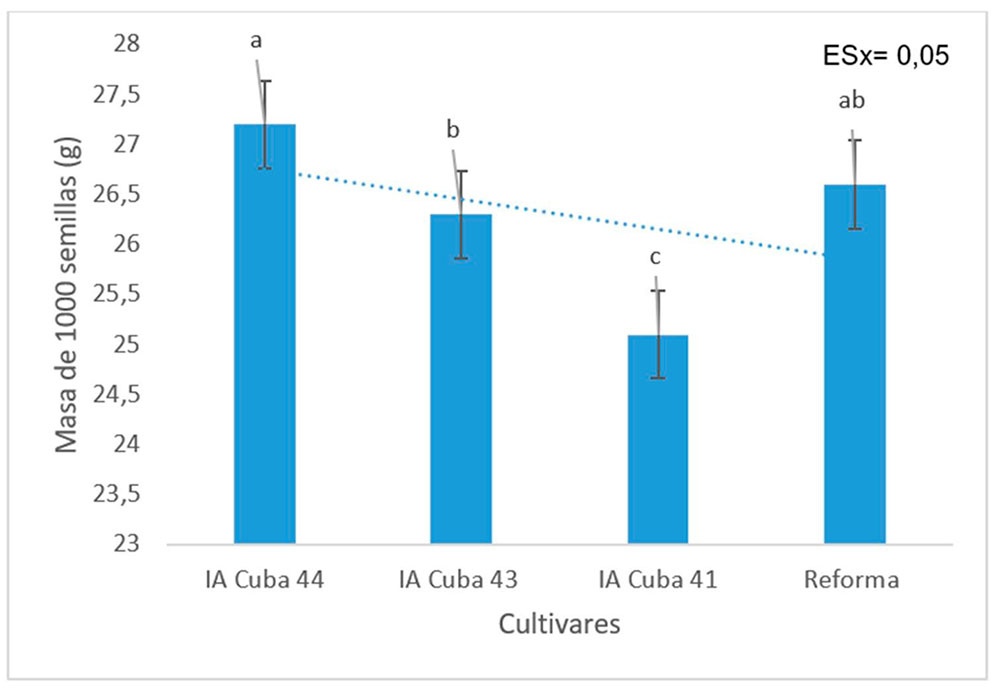
Rice cultivars with the best agricultural productivity, adaptation, and yields during the cold season were selected. The research was carried out at the Fernando Echenique Urquiza Credit and Services Cooperative (CCS), located in the Río Cauto municipality, Granma province, Cuba. Initially, a seed germination test was conducted to determine seed quality and the most appropriate planting procedure. The cultivars evaluated were Reforma, IA Cuba 41, 43, and 44 (control). Sowing was carried out manually during the cold season, in January. Pre-germinated seeds were sowed by specialized rice-sowing teams. The following indicators were measured: plant height (cm), 1000-grain mass (g), and yield (t.ha-1). The experiment was conducted according to a randomized block design with three replicates. Pest and disease tolerance of the cultivars was evaluated according to standard systems for rice cultivation using a susceptible control. As a result, all cultivars responded well, but only the Reforma cultivar stood out, achieving the best tolerance and adaptability to cold conditions, with a yield value exceeding 7,0 t.ha-1
Article Details

This work is licensed under a Creative Commons Attribution-NonCommercial 4.0 International License.
Those authors who have publications with this journal accept the following terms of the License Attribution-NonCommercial 4.0 International (CC BY-NC 4.0):
You are free to:
- Share — copy and redistribute the material in any medium or format
- Adapt — remix, transform, and build upon the material
The licensor cannot revoke these freedoms as long as you follow the license terms.
Under the following terms:
- Attribution — You must give appropriate credit, provide a link to the license, and indicate if changes were made. You may do so in any reasonable manner, but not in any way that suggests the licensor endorses you or your use.
- NonCommercial — You may not use the material for commercial purposes.
- No additional restrictions — You may not apply legal terms or technological measures that legally restrict others from doing anything the license permits.
The journal is not responsible for the opinions and concepts expressed in the works, they are the sole responsibility of the authors. The Editor, with the assistance of the Editorial Committee, reserves the right to suggest or request advisable or necessary modifications. They are accepted to publish original scientific papers, research results of interest that have not been published or sent to another journal for the same purpose.
The mention of trademarks of equipment, instruments or specific materials is for identification purposes, and there is no promotional commitment in relation to them, neither by the authors nor by the publisher.
How to Cite
References
Acosta LAV. (2020). Comportamiento de cinco variedades de arroz (Oryza sativa L.) en suelos salinos, en el cantón de San Jacinto de Yaguachi. Trabajo de Titulación. Ecuador”, Guayaquil. p.56. Disponible en: https://repositorio.ug.edu.ec y https://oa.mg
Baểta dos Santos A, Stone LF, Heinemann AB, Baểta dos Santos TP. (2017). Indices fisiològicos do arroz irrigados afectados pela inundaoςặo e fertilizaςặo nitrogenada. Revista CERES, 64(2),122-131. https://doi.org/10.1590/0034-737X20176420003
Chipana Valero C, Manzaneda Delgado F, Choque Tarqui C. (2022). Evaluación de dos variedades de arroz (Oryza sativa L) en dos sistemas de manejo de suelo en Sapecho Alto-Beni. Revista de Investigaciones e Innovaciòn Agropecuaria y Recursos Naturales. Bolivia: 6(1): 7-8. ISSN:2518 -6868.
Cristos Valdés E, González Cepero M, Pérez León N. (2021). ALAIN.-26 Nuevo cultivar de arroz (Oryza sativa L.) obtenida por cultivo in vitro de antera. Cultivos Tropicales, vol. 42, no.4, supl. 1, e10 ISSN digital: 1819-4087. http://ediciones.inca.edu.cu
Echevarría A, Cruz A, Pérez N, Cárdenas RM, Rivero D, Fabre L. (2010). Respuesta de 18 líneas de arroz (Oryza sativa L.) ante la piriculariosis en la época poco lluviosa. Cultivos Tropicales, 2010, vol. 31, no. 2, p. 17-20 SciELO Cuba. Disponible en: http://scielo.sld.cu › pdf › ctr › ctr03210
Hernández Jiménez A, Pérez Jiménez J, Bosch Infante D, Castro Speck N. (2019). La clasificación de suelos de Cuba: énfasis en la versión de 2015. Cultivos Tropicales, 40(1):1-31. ISBN: 1819-4087
INIA (2016). Oryza sativa. Disponible en: http://www.inia.uy/Paginas/aspx?requestUrl y http://www.inia.uy/Documentos/P%C3%BAblicos/INIA%20Tacuarem.
International Rice Research Institute (IRRI). (2002). Standard evaluation system for rice (SES) p. 60. Disponible en: www.knowlegebankirr.org/ses/top/htm
MINAG (1985). Manual de técnicas químicas de suelo, plantas y agua. Academia de Ciencias de Cuba. La Habana, Cuba.
Ministerio de Agricultura y Ganadería de Ecuador (2023). Boletín situacional del cultivo del arroz. Quito -Ecuador. Disponible en: https://n9.cl/eo2ka
Painii Montero VF, Vivas Vivas ML, Duran Mera CA, Santillán Muñoz OB, Barcos Árias MS. (2025). Características morfológicas e industriales en cultivares de arroz ”Vince UG-03” y “Vince UG-10” en la costa ecuatoriana. Revista Ciencia y Tecnologia,18(21) 23-30. https://doi.org/10.18779/cyt.v18i1.860
Rivero EL, Suárez CE. (2001) Instructivo Técnico. Cultivo del arroz. Editorial del Instituto de Investigaciones de Granos. Cuba, 43 p.
Rosero M. (1983). Sistema de evaluación estándar de cultivo del arroz. Centro Internacional Agrícola Tropical (CIAT), Cali, Colombia. 61p. Disponible en: https://alliancebioversityciat.org./publications-data/sistema-de-evaluation-estandar-para-arroz
Sánchez C. (2020). Norma de riego y frecuencia en cultivo de arroz. Editorial ABC. Disponible en: https://tecnologia.iniap.gob.ec
Sánchez S. (2019). Evaluación agronómica de las variedades de arroz (Oryza sativa L.) SFL - 011 e INIA 512 - Santa Clara en condiciones de riego. Universidad Católica de Santiago de Guayaquil. Facultad de Educación Técnica para el Desarrollo. Carrera de Ingeniería Agropecuaria. Guayaquil - Ecuador. Disponible en: https://repositorio.ucsg.edu.ec
Suárez Crestello E, Rivero Landeiro LE. (2015). Asociación de técnicos Agrícolas y Forestales. Habana. Cuba. ISBN: 978-959-7210-86-3
Vecilla, J. (2020). Enmiendas orgánicas como alternativas de manejo en suelos afectados por salinidad en el cultivo de arroz (Oryza sativa L.). (Tesis) [Universidad Técnica de Babahoyo Facultad]. Babahoyo, Ecuador. Disponible en: https://dspace.utb.edu.ech