
Physico-chemical variability of the fruits of a population of soursop (Annona muricata L.) conserved in situ in southern Manabi, Ecuador
Article Sidebar
Main Article Content
Abstract
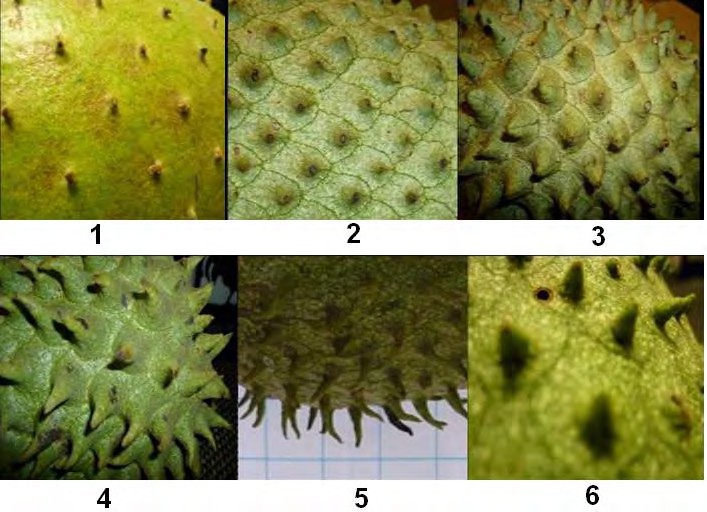
Soursop in southern Manabi produces exquisite fruits of different flavors, sizes and shapes. Despite having a great commercial importance, the physico-chemical characteristics of the fruits have been little studied. The objective of this research was to determine the physico-chemical variability of the fruit in a population conserved in situ in southern Manabi, Ecuador. Eleven quantitative variables (weight, circumference, length, emergency density of exocarp, number and weight of seed, percentage of pulp, total soluble solids, titratable acidity, maturity ratio and dry matter) and two qualitative variables (shape of fruit and emergencies of exocarp) were evaluated. To determine the variability of the data, a principal component analysis, correlation analysis (Pearson) and hierarchical cluster aggregation (Ward) was performed. To the quantitative data were determined their range of variation, and to the qualitative data, their statistical frequency. The 73,84% of the total variability was obtained in the first four components, and the 11 variables studied seven contributed the greatest variability. Positive correlations between the characters studied were observed, and the dendrogram formed three groups. Six forms of fruits and emergency of exocarp were determine, of which the most frequent were ovoid fruits and emergencies with acute apex of up to 5 mm in length. The results show the physico-chemical variability of the fruit and the presence of accessions that stand out in these characters, which may be used in future breeding programs of this species.
Article Details

This work is licensed under a Creative Commons Attribution-NonCommercial 4.0 International License.
Those authors who have publications with this journal accept the following terms of the License Attribution-NonCommercial 4.0 International (CC BY-NC 4.0):
You are free to:
- Share — copy and redistribute the material in any medium or format
- Adapt — remix, transform, and build upon the material
The licensor cannot revoke these freedoms as long as you follow the license terms.
Under the following terms:
- Attribution — You must give appropriate credit, provide a link to the license, and indicate if changes were made. You may do so in any reasonable manner, but not in any way that suggests the licensor endorses you or your use.
- NonCommercial — You may not use the material for commercial purposes.
- No additional restrictions — You may not apply legal terms or technological measures that legally restrict others from doing anything the license permits.
The journal is not responsible for the opinions and concepts expressed in the works, they are the sole responsibility of the authors. The Editor, with the assistance of the Editorial Committee, reserves the right to suggest or request advisable or necessary modifications. They are accepted to publish original scientific papers, research results of interest that have not been published or sent to another journal for the same purpose.
The mention of trademarks of equipment, instruments or specific materials is for identification purposes, and there is no promotional commitment in relation to them, neither by the authors nor by the publisher.
How to Cite
References
Ávila, R.; Pérez, M.; Giménez, A.; Hernández, E. (2012). La guanábana: una materia prima saludable para la industria de alimentos y bebidas. Revista Digital de Investigación y Postgrado de la Universidad Nacional Experimental Politécnica “Antonio José de Sucre”. Venezuela, 2(2): 134-142.
Badrie, N.; Schauss, A.G. (2010). Soursop (Annona muricata L.): composition, nutritional value, medicinal uses, and toxicology. In: Bioactive foods in promoting health: fruits and vegetables. Elsevier Inc, USA, pp 621-643
Benavides, G.A. (2002). Caracterización numérica del germoplasma de guanábana (Annona muricata L) muestreado in situ en el Pacífico y norte de Nicaragua. Universidad Nacional Agraria. Programa de recursos fitogenéticos nicaragüenses, Nicaragua. pp: 9.
Brito, G.B.; Vásquez, W. (2013). Manual para el Control de Calidad en la Pre y Poscosecha de las Frutas. Documento interno del Departamento de nutrición y Calidad y del Programa Nacional de Fruticultura. INIAP. Quito, Ecuador. 32p.
Cubero, J.I. (2013). Introducción a la Mejora vegetal. Tercera edición revisada y ampliada. Edicones Mundi Prensa. ISBN: 978-84-8476- 655-1. España. pp: 569.
FAO (2011). Introduction to the International Treaty on Plant Genetic Resources for Food and Agriculture. Rome. pp: 170.
Franco, T.L.; Hidalgo, R. (eds.). (2003). Análisis Estadístico de Datos de Caracterización Morfológica de Recursos Fitogenéticos. Boletín técnico no. 8, Instituto Internacional de Recursos Fitogenéticos (IPGRI), Cali, Colombia. 89 p.
Herbst M. C.; D. Litt and B. Cur. (2013). Fact Sheet and position statement on Soursop (Graviola) Edited by Sue Janse van Rensbur and B. Hons. Cancer Association of South Africa, 6 pp.
Hernández, V.A. (2013). Caracterización morfológica de recursos fitogenéticos. Universidad Autónoma de Nayarit, Unidad Académica de Agricultura. Revista Biociencias, 2(3): 113-118.
Lemos, B.J.; Molina, G.; Dionisio, A.; Favio, F.; Wagner, R.; Maróstica, M.; Pástore, G. (2011). Volatile constituents of exotic fruits from Brazil. Food Research International. 44: 1843-1855.
Love K. and R. Paull. 2011. Soursop. College of Tropical Agriculture and Human Resources, University of Hawai at Manoa. UH-CTAHR F_N-
6 pp.
Miranda, D.; Arce, C.; Gómez, L.; Vasto, D.; Arboney, J.; Bravo, A. (2000). Conozcamos el Cultivo de Guanábana. Cartilla divulgativa. Corpoica regional 6. Caracterización de cultivares de guanábana (Annona muricata L.) Guanábana MIC. pp: 252.
Moreira, M.R.; Uguña, F. (2012). Instituto Nacional de Investigaciones Agropecuarias (INIAP) Memoria Técnica anual 2012 del Programa de Fruticultura, Estación Experimental del Litoral Sur. Proyecto SENESCYT. pp:70.
Moreira, M.R.; Héctor, E. (2014). Estado actual y perspectivas de desarrollo de la guanábana (Annona muricata L.) como cultivo comercial en el Sur de Manabí, Ecuador. Revista Alternativas. Universidad Católica de Santiago de Guayaquil. 5(2): 36-42.
Moreira M.R. (2015). Instituto Nacional de Investigaciones Agropecuarias (INIAP) Memoria Técnica anual 2015 del Programa de Fruticultura, Estación Experimental del Litoral Sur. pp:62.
Onyechy, U.; Uchena, A.; Vivienne, I.; Kiruka, N.; Eze, P. (2012). Nutrient and Phytochemical, Composition and Sensory evaluation of soursop (Annona muricata) Pulp and drink in South eastern Nigeria. International Journal of basic and Applied Sciences. 12 (6): 53-57.
Padmini S. M.; D. Pushpakumara and R. Samarasekera. 2013. Morphological characterization of Soursop (Annona muricata L.) germplasm in Sri lanka. Tropical Agriculture Research. Vol. 24 (4): 362-374.
Piña, E.J.; Vences, C.; Gutierrez, M.; Vásquez, L.; Arzate, A. (2010). Caracterización morfológica y molecular de nueve variedades botánicas de Tigridia pavonia (L.F.). Agrociencia, México, 44: 147-158.
Pinto, A.; Cordeiro, M.; Andrade, M.; Ferreira, F.; Filgueira, H.; Alves, R.; Kimpara, D. (2005). Annona species. International Centre for Underutilized Crop. University of Southamton. SO17 IBJ. UK. 268 pp.
Prasasti, N.E.; Sri, T.; Widiastuti, R. (2012). The breast anticancer from leaf extract of Annona muricata against cell line in T47D. International Journal of applied Science and technology. 2 (1): 8
Tacan, M. P. (2007). Caracterización agromorfológica e identificación de zonas potenciales de conservación y producción de guanábana (Annona muricata) y chirimoya (Annona cherimola) en fincas de agricultores y condiciones ex situ en Costa Rica. Centro Agronómico Tropical de Investigación y Enseñanza. Tesis de Postgrado. CATIE. pp: 115.
Ward, J.H. (1963). Hierarchical grouping to optimize and objective function. Journal of the American Statistical Association (USA) 58: 236-244.