
New Cuban varieties of pepper under conditions of open field, with high quality fruit and resistant to Potyvirus
Article Sidebar
Main Article Content
Abstract
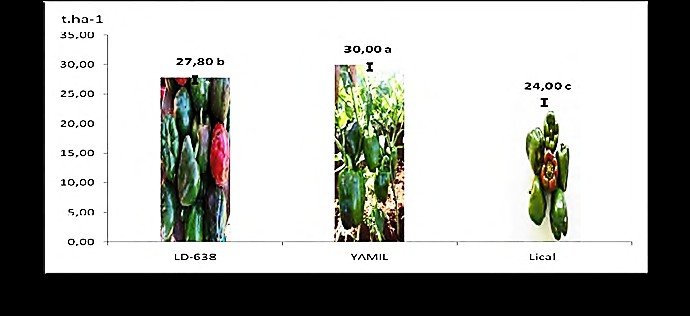
The rehearsal was carried out in the Institute of Horticultural Investigations "Liliana Dimitrova" located in the municipality of Quivicán, county of Mayabeque. The behavior of two new Cuban varieties of pepper was analyzed (LD-638 and YAMIL) under conditions of open field. The varieties were compared with the commercial variety LICAL like witness (T), to which were evaluated some variants of growth and productive, as well as the chemical properties of the fruits. The statistical design of blocks was used at random with three replicas. The two new varieties of pepper type California Wonder LD-638 and YAMIL showed good adaptation to the tropical conditions and superior potential yields to the witness. The variety LD-638 presented the best values as for total soluble solids and pH, while the variety YAMIL expressed a bigger acidity percent and vitamin content C. The obtained results they allow to recommend the two new pepper varieties for its validation in the production system.
Article Details

This work is licensed under a Creative Commons Attribution-NonCommercial 4.0 International License.
Those authors who have publications with this journal accept the following terms of the License Attribution-NonCommercial 4.0 International (CC BY-NC 4.0):
You are free to:
- Share — copy and redistribute the material in any medium or format
- Adapt — remix, transform, and build upon the material
The licensor cannot revoke these freedoms as long as you follow the license terms.
Under the following terms:
- Attribution — You must give appropriate credit, provide a link to the license, and indicate if changes were made. You may do so in any reasonable manner, but not in any way that suggests the licensor endorses you or your use.
- NonCommercial — You may not use the material for commercial purposes.
- No additional restrictions — You may not apply legal terms or technological measures that legally restrict others from doing anything the license permits.
The journal is not responsible for the opinions and concepts expressed in the works, they are the sole responsibility of the authors. The Editor, with the assistance of the Editorial Committee, reserves the right to suggest or request advisable or necessary modifications. They are accepted to publish original scientific papers, research results of interest that have not been published or sent to another journal for the same purpose.
The mention of trademarks of equipment, instruments or specific materials is for identification purposes, and there is no promotional commitment in relation to them, neither by the authors nor by the publisher.
How to Cite
References
Alvarado, Mayra y Cabrera, Lorena. 2010. Determinación del tiempo de vida útil en los pimientos california verdes fresco en bandejas plásticas empacados con papel film. Seminario de graduación previa a la obtención del Título de Tecnólogo en alimentos. Programa de tecnología en alimentos. Escuela Superior Politécnica del Litoral Guayaquil- Ecuador 11 de febrero del 2010.47p.
Andrade-Cuvi, María José; Moreno- Guerrero, Carlota; Henríquez-Bucheli, Alejandra; Gómez-Gordillo, Alejandra y Concellón, Analía. 2010. Influencia de la radiación UV-C como tratamiento postcosecha sobre carambola (Averroha carambola L.) mínimamente procesada almacenada en refrigeración. Revista iberoamericana de tecnología Postcosecha, 11, no. 1, p: 18-25.
Antonini, A.; Robles, W.; Tessorioli, J.; y Kluge, R. 2002. Capacidad productiva de cultivares de berenjena. Hortic. Bras. 20 (4): 646-648.
Casanova, A.; Gómez, Olimpia; Pupo, F. R.; Hernández, M.; Chailloux, Maritza; Depestre, T.; Pupo, F. R.; et al. 2007. Manual para la Producción Protegida de Hortalizas. MINAG- Viceministerio de Cultivos Varios- IIHLD, La Habana, Cuba., 112 p.
Díaz, A.; Quiñones, M.; Hernández, A.; del Barrio, G. 2010. Evaluación de los parámetros analíticos para la detección molecular de potyvirus que afectan al cultivo del pimiento en Cuba. Rev Protección Veg. 25 (2): 80-87.
Domene, M.A.; Gázquez, J.C.; Segura, M.D. y Meca, D.E. 2014. Evaluación de la calidad interna en especialidades de pimientos: Sustancias nutritivas y bioactivas. Actas de horticultura y jornadas del grupo de alimentación y salud. Negocio Agroalimentario y Cooperativo. Sociedad Española de Ciencias Hortícolas 65: 157-162.
Esteban, M.; Arredondo, A. y Tholwerd, H. 2010. Pimiento, caracteres productivos. [en línea]. 4 p. [fecha de consulta: 11 de mayo, 2012]. http://w.w.w.buenastareas.com/ensay os/Pimiento/801556.html.
Fernández, L. J.; Liverottio, O.; Sánchez, G. 2012. Manejo postcosecha de pimiento. (en Línea). 3 p. [fecha de consulta: 29 de julio, 2014]. : www.mercadocentral.gob.ar/ziptecnic as/pimiento.pdf.
Hernández, A.; Pérez, J.M.; Bosch, D.; Rivero, L. 1999. Nueva versión de clasificación genética de los suelos de Cuba. AGRINFOR, La Habana, 24p.
IBPGRI.1990. “International Board for Plant genetic Resources”. Genetic resources of capsicum: a global plan of action. IBPGR Secretariat, Rome, Italy. 49 p.
González, Ivonne; Yailen Arias; Madelaine Quiñones; Ileana Miranda; Yaritza Rodríguez y Belkis Peteira. 2011. Variabilidad Molecular de Genotipos de Pimiento (Capsicum Annuum L.) Prog. de Mejoramiento Genético para la Resistencia a PVY. Rev. Protección Veg., 26 (2): 69-72.
Gualoto, Lorena; Suquelanda, M.; Labama, M. 2011. Respuesta del cultivo del pimiento (Capsicum annuum L) bajo invernadero a la aplicación foliar complementaria con tres tipos de abono de fruto. [en línea]. 38 p. [fecha de consulta: 11 de mayo del 2012]. Disponible en: http://w.w.w.buenastareas.com/ensayos/Fertilización%C3B2n-or%C3%aonica-V%C3%a–la-foliar-del-pimiento/1503340.html.
Nuez Vi als F.; Gil Ortega R. y Costa García J. 1996. El cultivo de pimientos chiles y ajíes. Editorial Mundi Prensa. España: 607p.
ONE (Oficina Nacional de Estadísticas). 2012. Cuba. [en línea]. 2 p. [fecha de consulta 15 de mayo del 2012]. Disponible: http://www.one.cu/acc.2010/esp/09-tabla-cuadro.htm