
Decontamination method for in vitro establishment of garlic (Allium sativum L.) bulbs
Article Sidebar
Main Article Content
Abstract
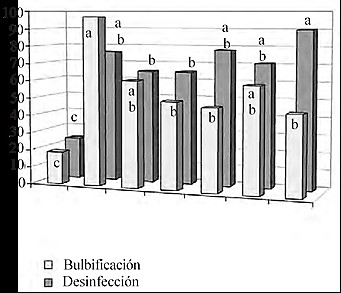
Apices of garlic bulbs (cloves) are vigorous explants for tissue culture practices, but they usually present high contamination levels with soil microorganisms, due to they are underground growing organs. The experiments were done to compare different decontamination variants of garlic clove, with sodium hypochlorite solutions (0.5- 5% available chlorite) or a 0.1% mercuric chlorite, as disinfectants. During explants development, contaminated plants and alive plants were quantified, in order to evaluate culture survival. Plantlet development was evaluated every 15 days, quantifying the number of leaves, roots, and bulblets. Applying 5% sodium hypochlorite during 15 min, followed of cutting 1 mm of the most external layer and flaming the base of garlic bulb, acceptable disinfection levels of garlic cloves were obtained, with decontamination percentages ranging around 70%, without plant damage.
Article Details

This work is licensed under a Creative Commons Attribution-NonCommercial 4.0 International License.
Those authors who have publications with this journal accept the following terms of the License Attribution-NonCommercial 4.0 International (CC BY-NC 4.0):
You are free to:
- Share — copy and redistribute the material in any medium or format
- Adapt — remix, transform, and build upon the material
The licensor cannot revoke these freedoms as long as you follow the license terms.
Under the following terms:
- Attribution — You must give appropriate credit, provide a link to the license, and indicate if changes were made. You may do so in any reasonable manner, but not in any way that suggests the licensor endorses you or your use.
- NonCommercial — You may not use the material for commercial purposes.
- No additional restrictions — You may not apply legal terms or technological measures that legally restrict others from doing anything the license permits.
The journal is not responsible for the opinions and concepts expressed in the works, they are the sole responsibility of the authors. The Editor, with the assistance of the Editorial Committee, reserves the right to suggest or request advisable or necessary modifications. They are accepted to publish original scientific papers, research results of interest that have not been published or sent to another journal for the same purpose.
The mention of trademarks of equipment, instruments or specific materials is for identification purposes, and there is no promotional commitment in relation to them, neither by the authors nor by the publisher.
How to Cite
References
Bekheet, S.A. A synthetic seed method through encapsulation of in vitro proliferated bulblets of garlic (Allium sativum L.). Arab J. Biotech. 2006, Vol. 9 (3): 415-426.
Burba, J.L. Los grupos varietales del ajo (Allium sativum L.). Contribución para su entendimiento. Horticultura Argentina. 2008, 27(62): 20-27.
ECP/GR Working group on Allium. 2006. Progress report for the period 2003-2006.http://www.ecpgr.cgiar.org/SteeringCommittee/SC10/StandRep/Allium_standrep.pdf: 21 de septiembre del 2009.
Keller, J. y D.E. Lesemann. 1997. Application of in vitro culture to onion and garlic for the management and use of genetic resources at Gatersleben. Proc.I Symp. Edible Alliaceae SecIL: Burba and C.R. Galmarini Acta Hort. 433.ISHS 1997.
Kim, H.H.; Lee J. K.; Hwang, H.S. and F. Engelmann. 2007. Cryopreservation of garlic germplasm collections using the droplet-vitrification technique. CryoLetters 28 (6), 471-482.
Hassan, N. A.; A. A. El-Halwagi; A. Gaber; M. Al-Awady y A. Khalaf. 2007. Slow growth in vitro conservation of garlic cultivars grow in Egypt: chemical characterization and molecular evaluation. 2007. Global Journal of Molecular Sciences. 2 (2): 67-75.
Izquierdo, H.; Disotuar, R.; Qiñonez Y.; y Bejerano, J. M. 1998. Efectividad de diferentes agentes químicos en la desinfeccion de Allium sativum L. para su implantacion in vitro Taller Internacional «Geminivirus en el Caribe», La Habana, Cuba.
Makowska, Z. J. Keller y F. Engelmann.1999. Cryopreservation of apices isolated from garlic (Allium sativum L.) bulbils and cloves. Cryo-Letters 20: 175- 182.
Muñoz, L.; L. Almaguel; M. Benítez; G. Brito; I. Cáceres; J. J. Castellanos; S. Fraga; J. F. Gil; M. López; A. Prats. 2010. El cultivo y mejoramiento de la producción de ajo en Cuba. Agricultura Organica. 1: 18-21.
Murashige, T.; F. Skoog,. 1962. A revised meduim for rapid growth and bioessays with tobacco tissue cultures. Physiol. Plant. 15: 473-497.
Neveen A. H.; A. A. El-Halwagi, A. Gaber, M. El-Awady y A. 2007. Khalaf. Slow-Growth in vitro conservation of garlic cultivars grow in Egypt. Global Journal of Molecular Sciences 2 (2): 67-75.
Seif El-Nasr H. GadEl-Hak; , A. Z. Kasem ; M.M.M. Yasser y E. S. Asmaa. 2011. Growth and cytogenetical properties of micro-propagated and successfully acclimatized garlic (Allium sativum L.) clones with a modified shoot tip culture protocol. Journal of Horticultural Science & Ornamental Plants 3 (2): 115-129.
Shemesh, E; O.Scholten, H. D. Rabinowitch y R. Kamenetsky.2008. Unlocking variability: inherent variation and developmental traits of garlic plants originated from sexual reproduction. Planta.227(5):1013- 1024.
Stavìlíková, H. 2008. Morphologycal characteristics of garlic (Allium sativum L.) genetic resources collection- Information. Hort. Sci. (Prague) 35 (3): 130-135.
Torres M. A.; M. R. López, A. J. Rodríguez y M. Benítez. 2008. Conservación de germoplasma de ajo (Allium sativum L.) por reducción de la tasa de crecimiento. Agrotecnia de Cuba. 32 (2):46-55.