
Effect of the peduncle and leaf sheath dry mass on the grain filling of four cuban rice cultivars (Oryza sativa L.)
Article Sidebar
Main Article Content
Abstract
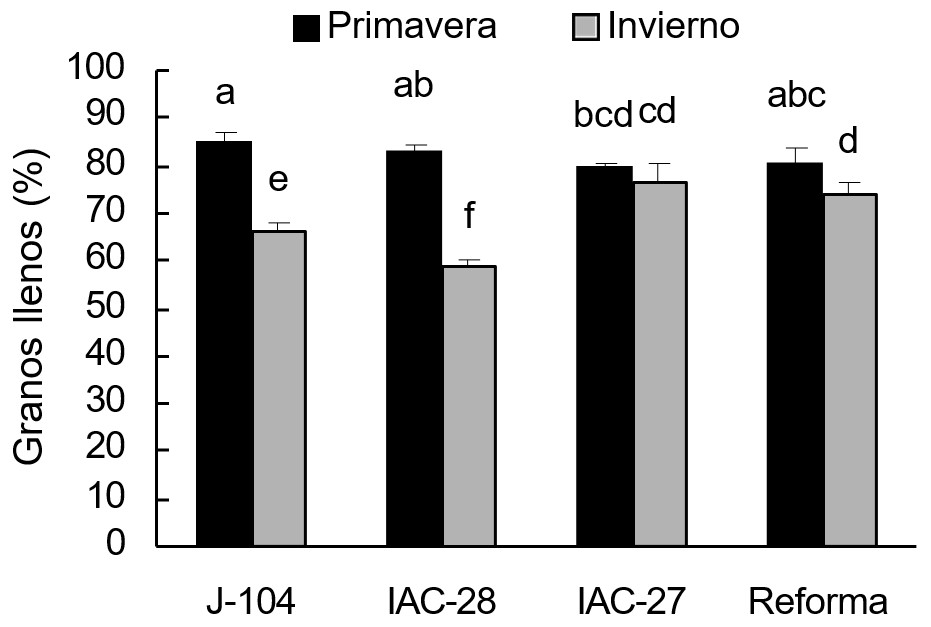
The aim of this paper was to determine the effect of the sowing date on the dry matter mobilization from the peduncle and the leaf sheath, and its influence on the grain filling of the Cuban rice varieties J-104, IAC-27, IAC-28 and Reforma. The experiment was carried out in two planting dates, according to a randomize block design with 4 replicates. The peduncle and the leaf sheath dry mass were determined at the onset of heading, at 50% heading, at the milky stage and at harvest. The leaf area was evaluated at the milky stage and the rate of reserves mobilization was calculated during the grain filling. The yield components were determined at harvest. The results showed that the dry mass reserves were mobilized from the peduncle and the leaf sheath in the wet season, which could explained the higher percentage of filled grains found in this planting date. Despite the highest values of leaf area observed at the milky stage in the dry season, the percentage of filled grains was lower, coinciding with the absence of reserves mobilization from the stem. The results of this experiment highlights the importance of developing management practices appropriate to each planting date, to increase the expression of the yield potential, that is, a high number of spikelets per plant and a high grain filling quality.
Article Details

This work is licensed under a Creative Commons Attribution-NonCommercial 4.0 International License.
Those authors who have publications with this journal accept the following terms of the License Attribution-NonCommercial 4.0 International (CC BY-NC 4.0):
You are free to:
- Share — copy and redistribute the material in any medium or format
- Adapt — remix, transform, and build upon the material
The licensor cannot revoke these freedoms as long as you follow the license terms.
Under the following terms:
- Attribution — You must give appropriate credit, provide a link to the license, and indicate if changes were made. You may do so in any reasonable manner, but not in any way that suggests the licensor endorses you or your use.
- NonCommercial — You may not use the material for commercial purposes.
- No additional restrictions — You may not apply legal terms or technological measures that legally restrict others from doing anything the license permits.
The journal is not responsible for the opinions and concepts expressed in the works, they are the sole responsibility of the authors. The Editor, with the assistance of the Editorial Committee, reserves the right to suggest or request advisable or necessary modifications. They are accepted to publish original scientific papers, research results of interest that have not been published or sent to another journal for the same purpose.
The mention of trademarks of equipment, instruments or specific materials is for identification purposes, and there is no promotional commitment in relation to them, neither by the authors nor by the publisher.
How to Cite
References
Aranjuelo I., Cabrera-Bosquet L., Morcuende R., J., Nogués S., Araus J.L., Martínez-Carrasco R. y Péez P. (2011). Does ear C sink strength contribute to overcoming photosynthetic acclimation of wheat plants exposed to elevated CO2? J. Exp. Bot. 62 (11): 3957-3969.
Chen S., Zheng F., Pao Z., Zhang G. (2008). Characterization of high-yield performance as affected by genotype and environment in rice. J. Zhejiang Univ. Sci. B. 9 (5): 363-370.
Dorado-Bermúdez M., García A., Pérez I., Palacio Z., Torres M. y Escandón Y. (2006). Comportamiento de la masa seca de lámina de la hoja bandera de plantas de arroz (Oryza sativa L. var. J-104) durante el llenado de los granos. Agrotecnia de Cuba 30: 9-15.
Dorado-Bermúdez M., García A., y Pérez I. (2011). Acumulación y movilización de materia seca en los entrenudos del tallo principal de plantas de arroz (Oryza sativa L. var. J-104). Agrotecnia de Cuba 35 (2): 30-41. Duan M., Sun S. (2005). Profiling the expression of genes controlling rice grain quality. Plant Molecular Biology 59: 165-178.
Fukushima A., Shiratsuchi H., Yamaguchi H. y Fukuda A. (2011). Effects of nitrogen application and planting density on morphological traits, dry matter production and yield of large grain type rice variety Bekoaoba and strategies for super high-yielding rice in the Tohoku Region of Japan. Plant Prod. Sci. 14 (1): 56-63.
Hirose T., Endler A., Ohsugi R. (1999). Gene expression of enzymes for starch and sucrose metabolism and transport in leaf sheath of rice (Oryza sativa L.) during the heading period in relation to the sink to source transition. Plant Prod. Sci. 2 (3): 178-183.
Ida M., Ohsugi R., Sasaki H., Aoki N., y Yamagishi T. (2009). Contribution of nitrogen absorbed during ripening period to grain filling in a high-yielding rice variety Takanari. Plant prod. Sci. 12 (2):176-184.
IIArroz (2005). Instructivos Técnicos para el Cultivo del Arroz. Instituto de Investigaciones del Arroz. Bauta. Cuba. 113p. Instituto de Suelos (1999). Nueva Versión de Clasificación Genética de los Suelos de Cuba. Ministerio de la Agricultura. La Habana, Cuba. 64 pp.
IRRI. (2002). Standard Evaluation System for Rice. Genetic Resources Center. INGER. 4th. Edition. Manila. Philippines. 56 pp.
Kanbe T., Sasaki H., Aoki N., Yamagishi T. y Ohsugi R. (2009). The QTL analysis of RuBisCO in flag leaves and non- structural carbohydrates in leaf sheaths of rice using chromosome segment substitution lines and backcross progeny F populations. Plant Prod. Sci. 12 (2): 224-232. Kato T. (2010). Variation and association of the traits related to grain filling in several extra-heavy panicle type rice under different environments. Plant Prod. Sci. 13 (1): 185-192.
Kumagai E., Araki T., Ueno O. (2010). Comparison of susceptibility to photoinhibition and energy partitioning of absorbed light in photosystem II in flag leaves of two rice (Oryza sativa L.) cultivars that differ in their responses to nitrogen-deficiency. Plant Prod. Sci. 13 (1): 11-20.
Liu G.L., Mei H.H., Zhou G.H., Liu H.Y., Hu S.P., Li M.S., Wu T.H., Chen L., y Luo L. J. (2008). QTL analysis of panicle neck diameter, a trait highly correlated with panicle size under well-watered and drought conditions in rice. Plant Prod. Sci. 174: 71-77.
Takahashi S., Ishimaru K., Yazaki J., Fujii F., Shimbo K., Yamamoto K., Sakata K., Sasaki T., Kishimoto N., y Kukushi S. (2005). Microarray analysis of sink-source transition in rice leaf sheaths. Breeding Science 55: 153-162. Taylaran, R., Adachi, S., Ookawa, T., Usuda, H. and Hirasawa, T. (2011). Hydraulic conductance as well as nitrogen accumulation plays a role in the higher rate of leaf photosynthesis of the most productive variety of rice in Japan. J. Exp. Bot. 62 (11): 4067-4077
Tsukaguchi T, Horie T, Ohnishi M. (1996) Filling percentage of spikelets as affected by availability of non-structural carbohydrates at the inicial phase of grain filling. Jpn. J. Crop Sci. 65 (3): 445-452.
Xin, Y. y Zhang, Q. (2010). Genetic and molecular bases of rice yield. Ann. Rev. Plant Biol. 61: 421-442.
Yang J., Peng S., Zhang Z., Wang Z., Visperas R.M., Zhu Q. (2002). Grain and dry matter yields and partitioning of assimilates in Japonica/Indica hybrid rice. CropSci.42:766-772.