
Agro-biodiversity conservation and its impact on agri-food systems in Cuba
Article Sidebar
Main Article Content
Abstract
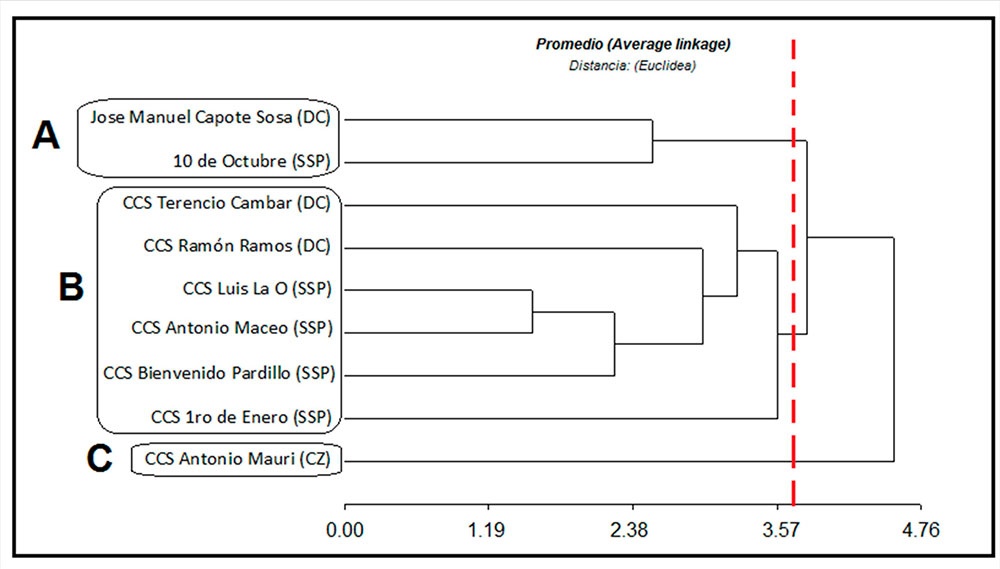
The conservation of agrobiodiversity involves, among its actions, gathering greater local knowledge of species and accession variability, while counteracting other threats such as fragmentation, illegal logging, and the presence of invasive exotic species. The GEF-FAO "COBIMAS" project impacts on the genetic resources conservation with importance for food and Agriculture in four protected areas (PA) of Cuba: Ciénaga de Zapata, Jobo Rosado, Tunas de Zaza and Delta del Cauto. In this paper, the main results obtained in the information survey of agricultural biodiversity are presented, according with the productive units associated to the PAs and the conservation actions. A baseline of all beneficiaries is presented, including the classification of agricultural management practices, implemented in each productive unit and compared through a multivariate (cluster) analysis. Areas under sustainable soil management that introduced practices in harmony with the environment were quantified, as well as the identification, conservation and rescue of genotypes with high tolerance to edaphoclimatic conditions. The multivariate study confirmed the existence of a biodiversity of phyto and zoogenetic resources in the implementation areas. Collections of traditional seeds from several crops were carried out, and seeds of a watermelon variety with potential tolerance to salinity were collected for multiplication in other regions of the country. Nurseries were set up using local Annonaceae seeds, to support their reintroduction and diversification into the Jobo Rosado AP, with 4,279 plants. In addition, groups of wild relatives of Ipomoea, Oryza, and Capsicum were identified and characterized in the PAs.
Article Details

This work is licensed under a Creative Commons Attribution-NonCommercial 4.0 International License.
Those authors who have publications with this journal accept the following terms of the License Attribution-NonCommercial 4.0 International (CC BY-NC 4.0):
You are free to:
- Share — copy and redistribute the material in any medium or format
- Adapt — remix, transform, and build upon the material
The licensor cannot revoke these freedoms as long as you follow the license terms.
Under the following terms:
- Attribution — You must give appropriate credit, provide a link to the license, and indicate if changes were made. You may do so in any reasonable manner, but not in any way that suggests the licensor endorses you or your use.
- NonCommercial — You may not use the material for commercial purposes.
- No additional restrictions — You may not apply legal terms or technological measures that legally restrict others from doing anything the license permits.
The journal is not responsible for the opinions and concepts expressed in the works, they are the sole responsibility of the authors. The Editor, with the assistance of the Editorial Committee, reserves the right to suggest or request advisable or necessary modifications. They are accepted to publish original scientific papers, research results of interest that have not been published or sent to another journal for the same purpose.
The mention of trademarks of equipment, instruments or specific materials is for identification purposes, and there is no promotional commitment in relation to them, neither by the authors nor by the publisher.
How to Cite
References
Adhikari, P., Araya, H., Aruna, G., Balamatti, A., Banerjee, S., Baskaran, P., Barah, B. C., Behera, D., Berhe, T., Boruah, P., Dhar, S., Edwards, S., Fulford, M., Gujja, B., Ibrahim, H., Kabir, H., Kassam, A., Khadka, R. B., Koma, Y. S., Natarajan, U. S., Perez, R., Sen, D., Sharif, A., Singh, G., Styger, E., Thakur, A. K., Tiwari, A., Uphoff, N. y Verma, A. (2018). System of crop intensification for more productive, resource-conserving, climate-resilient, and sustainable agriculture: Experience with diverse crops in varying agroecologies. International Journal of Agricultural Sustainability, 16(1), 1-28. https://doi.org/10.1080/14735903.2017.1402504
Antón, N. A. (2014). Estrategia de capacitación agroecológica para la sostenibilidad alimentaria de la Comunidad Ecológica Río Ariguanabo (Tesis de maestría). Universidad de La Habana, Facultad Latinoamericana de Ciencias Sociales (FLACSO-CUBA).
Bernal-Fundora, A., Cabrera-Rodríguez, J. A. y Hernández-Jiménez, A. (2022). Calibración de la estabilidad estructural relacionada con el diámetro medio ponderado en diferentes suelos. Cultivos Tropicales, 43(4), octubre-diciembre. Disponible en https://ediciones.inca.edu.cu
Comino, J. R., Caballero-Calvo, A., Salvati, L. y Senciales-González, J. M. (2022). Sostenibilidad de los cultivos subtropicales: Claves para el manejo del suelo, el uso agrícola y la ordenación del territorio. Cuadernos Geográficos, 61(1), 150-167.
Corral, Y., Corral, I. y Franco, A. (2015). Procedimientos de muestreo. Revista Ciencias de la Educación, 26(46), 151-167. ISSN: 316-5917. ISBN 978-92-5-306871-5.
FAO. (2011). Ahorrar para crecer. Guía para los responsables de las políticas de intensificación sostenible de la producción agrícola en pequeña escala. FAO. Roma, 106 pp. ISBN 978-92-5-306871-5. Disponible en: https://www.fao.org
González, P. A. (2022). Inventarios florísticos en localidades del municipio Calixto García, provincia Holguín, Cuba. Acta Botánica Cubana, 221. Disponible en https://revistasgeotegh.com/abc/issue/view
Guillén, A., Badii, M. H., Prado, J. L., Abreu, J. L. y Valenzuela, J. (2011). Concept and application of cluster and systematic sampling. International Journal of Good Conscience, 6(2), 186-194. Disponible en https://www.spentamexico.org
Guzmán, O. (2021). Análisis espacial de las unidades productivas en el área protegida de los recursos manejados “Ciénaga de Zapata” (Tesis de licenciatura). Universidad de La Habana.
Guzmán, O., Socorro, A. y Herrera, A. (2023). Análisis espacial de las unidades productivas en el área protegida de los recursos manejados Ciénaga de Zapata. Agrotecnia de Cuba, 47(1), 1-10.
Hernández, R., Fernández, C. y Baptista, M. (2010). Metodología de la investigación (5ª ed.). McGraw-Hill/Interamericana Editores. S.A. de C.V., México D.F
Kruskal, WH, y Wallis, WA (1952). Uso de rangos en el análisis de varianza de un criterio. Journal of the American Statistical Association, 47, 583-621. http://dx.doi.org/10.1080/01621459.1952.10483441
Osorio-Espinoza, H., Leyva-Galán, A., Toledo-Toledo, E. y Marroquín-Agreda, F. J. (2023). Influencia de las coberturas vivas y muertas sobre las arvenses, en un agroecosistema con rambután (Nephelium lappaceum L.), en México. Cultivos Tropicales, 44(4), octubre-diciembre. Disponible en https://ediciones.inca.edu.cu
Pérez, A. (2020). Potencial productivo de dos melíferas cubanas: Ipomoea triloba L. y Turbina corymbosa (L.) Raf. (Tesis doctoral). Instituto Nacional de Ciencias Agrícolas (INCA), Mayabeque, Cuba.
Puig, N. (2019). Impacto de la capacitación en el manejo agrícola de los agricultores de Ciénaga de Zapata (Tesis de maestría). Universidad Agraria de La Habana, Mayabeque, Cuba.
Rayo-Álvarez, D., Uribe-Ceballos, J. R., Rodríguez-Restrepo, R. A., Cadavid-López, L. F. y Ortiz-Grisales, S. (2022). Formulación de fertilidad online para cultivos tropicales con base en análisis físico-químico del suelo. Acta Agronómica, 71(4), 388-395. https://doi.org/10.15446/acag.v71n4.106214
Socorro, A., Kaufmann, M., González, M., Hernández, Y., Sánchez, Y., Ortíz, L., Cristóbal, R. y Zamora, J. L. (2014). La capacidad agrícola de fincas de la Reserva de la Biosfera “Cuchillas del Toa”, municipio Baracoa. Agrotecnia de Cuba, 38(1), 34-44. ISSN: 2414- 4673
Tamayo-Ortiz, C. V. y Alegre-Orihuela, J. C. (2022). Asociación de cultivos, alternativa para el desarrollo de una agricultura sustentable. Siembra, 9(1), e3287. https://doi.org/10.29166/siembra.v9i1.3287.
Torres, M., Cotarelo, N., Cruz, A., Pérez, M., Araujo, J., Labrada, P. A. y Socorro, A. (2024). Características de la capa superior de suelos en fincas del norte de Delta del Cauto. Agrotecnia de Cuba, 48. https://cu-id.com/2120/v48e18 . https://agrotecnia.edicionescervantes.com/index.php/agrotecnia/article/view/799