
Morpho-agronomic characterization of watermelon (Citrullus lanatus (Thunb.) Matsum. et Nakai) in Cabezada locality, Granma province, Cuba
Article Sidebar
Main Article Content
Abstract
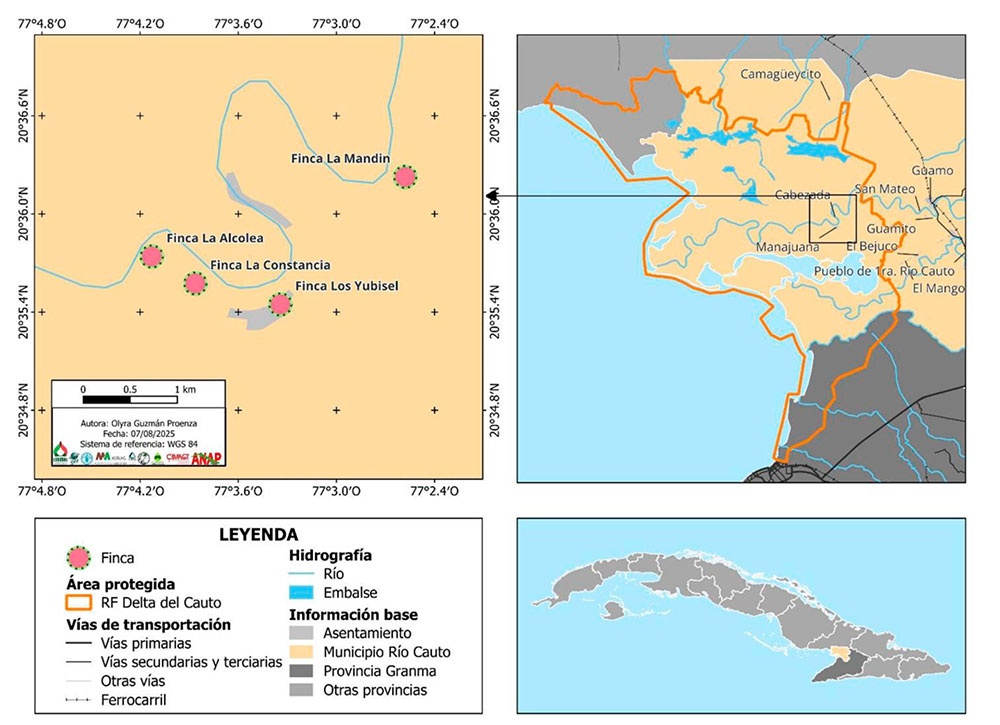
In Cuba, there are 12 commercial watermelon cultivars (Citrullus lanatus), but local germplasms have been less studied in scientific literature, a factor that accelerates their genetic erosion. The project "Introduction of New Agricultural Methods for the Conservation and Sustainable Use of Biodiversity" aims to conserve this crop in the community of Cabezada, located in the Wildlife Refuge Delta del Cauto, Granma, where the local cultivar 'Patisito' had previously been identified. This research morpho-agronomically characterized the local germplasm to verify its existence. The methodology included: 1) germplasm acquisition through surveys and seed collection from four farms of the Ramón Ramos Credit and Service Cooperative (in Cabezada locality), and 2) morphological characterization using minimum descriptors for Cucurbitaceae, statistical analyses, and Pearson's correlation coefficient. The experiment was established at the "Villegas" farm (Güira de Melena, Artemisa) with staggered planting to avoid cross-pollination. Results determined that the germplasm collected does not correspond to the 'Patisito' cultivar described for local farmers, showing heterogeneity in key identification traits. However, it showed homogeneity in five characteristics: prostrate growth habit, weak leaf lobulation, absence of hermaphrodite flowers, light green rind, and pink flesh. The positive correlation between heavier fruits and longer seeds suggests a population less selected for pulp. The homogeneous pink flesh indicates high lycopene accumulation, a possible adaptation to the salinity conditions of the Delta del Cauto. These findings reveal a risk of genetic erosion and highlight the relevance of in situ conservation of this locally adapted plant genetic resource.
Article Details

This work is licensed under a Creative Commons Attribution-NonCommercial 4.0 International License.
Those authors who have publications with this journal accept the following terms of the License Attribution-NonCommercial 4.0 International (CC BY-NC 4.0):
You are free to:
- Share — copy and redistribute the material in any medium or format
- Adapt — remix, transform, and build upon the material
The licensor cannot revoke these freedoms as long as you follow the license terms.
Under the following terms:
- Attribution — You must give appropriate credit, provide a link to the license, and indicate if changes were made. You may do so in any reasonable manner, but not in any way that suggests the licensor endorses you or your use.
- NonCommercial — You may not use the material for commercial purposes.
- No additional restrictions — You may not apply legal terms or technological measures that legally restrict others from doing anything the license permits.
The journal is not responsible for the opinions and concepts expressed in the works, they are the sole responsibility of the authors. The Editor, with the assistance of the Editorial Committee, reserves the right to suggest or request advisable or necessary modifications. They are accepted to publish original scientific papers, research results of interest that have not been published or sent to another journal for the same purpose.
The mention of trademarks of equipment, instruments or specific materials is for identification purposes, and there is no promotional commitment in relation to them, neither by the authors nor by the publisher.
How to Cite
References
Aguado, E., García, A., Iglesias-Moya, J., Romero, J., Wehner, T. C., Gómez-Guillamón, M. L., Picó, B., Garcés-Claver, A., Martínez, C., y Jamilena, M. (2020). Mapping a partial andromonoecy locus in Citrullus lanatus using BSA-seq and GWAS approaches. Frontiers in Plant Science, 11, 1243. Disponible en: https://www.frontiersin.org/journals/plant-science/articles/10.3389/fpls.2020.01243/full
Begué-Quiala, G., Planas, J. R. I., Rivera, D. G., Elías, O. C., Trejo, H. M. P., y Rodríguez, D. A. (2022). Cultivo y conservación de frijol por campesinos dispersos en la Reserva de Biosfera Cuchillas del Toa, evidencias del cambio climático. Agrotecnia de Cuba, 46(1), 12-22. Disponible en: https://www.agrotecnia.edicionescervantes.com/index.php/agrotecnia/article/view/40
Brickell, C. D., Alexander, C., Cubey, J. J., David, J. C., Hoffman, M. H. A., Leslie, A. C., Malécot, V., y Jin, X. (2016). International Code of Nomenclature for Cultivated Plants (9th ed.). International Society for Horticultural Science. Disponible en: https://www.ishs.org/sites/default/files/static/ScriptaHorticulturae_18.pdf
Choudhary, H., Padmanabha, K., Jat, G. S., y Behera, T. K. (2023). Challenges of traditional breeding in watermelon. En S. Kr. Dutta, P. Nimmakayala, y U. K. Reddy (Eds.), The Watermelon Genome, 85-130. Springer International Publishing. https://doi.org/10.1007/978-3-031-34716-0_7
Di Rienzo, J. A., Casanoves, F., y Balzarini, M. G. (2008). InfoStat (Versión 2008) [Software]. Grupo InfoStat, Universidad Nacional de Córdoba. Disponible en: http://www.infostat.com.ar
European Cooperative Programme for Plant Genetic Resources (ECPGR). (2008). Minimum descriptor lists for Cucurbita spp., Cucumber, Melon, Watermelon. Disponible en: https://www.ecpgr.org/working-groups/cucurbits/cucurbits-working-group-documents-and-publications-of-interest
Organización de las Naciones Unidas para la Alimentación y la Agricultura (FAO). (2014). Normas para bancos de germoplasma de recursos fitogenéticos para la alimentación y la agricultura (Edición revisada). Disponible en: https://www.fao.org/4/i3704s/i3704s.pdf
FAO. (2023). Guía práctica para la aplicación de las normas para bancos de germoplasma de recursos fitogenéticos para la alimentación y la agricultura: Conservación de semillas ortodoxas en bancos de germoplasma de semillas. Comisión de Recursos Genéticos para la Alimentación y la Agricultura, Roma, Italia. FAO. https://doi.org/10.4060/cc0021es
Gao, B., Sun, D., Yuan, G., An, G., Li, W., Liu, J., y Zhu, Y. (2022). Identification of salt tolerance of 121 watermelon (Citrullus lanatus L.) germplasm resources. Journal of Fruit Science, 39(9), 1597-1606. Disponible en: https://www.cabidigitallibrary.org/doi/full/10.5555/20220431670
Gong, C., Zhao, S., Yang, D., Lu, X., Anees, M., He, N., Zhu, H., Zhao, Y., y Liu, W. (2022). Genome-wide association analysis provides molecular insights into natural variation in watermelon seed size. Horticulture Research, 9, uhab074. https://doi.org/10.1093/hr/uhab074
González, D., Sánchez, Y., y Fernández, M. (2014). Análisis hidroquímico con fines de riego de aguas subterráneas de la provincia de Granma. Minería y Geología, 30(4), 38-54. Disponible en: http://www.redciencia.cu/geobiblio/paper/2015-Sanchez-GEO13-O7.pdf
Grumet, R., McCreight, J. D., McGregor, C., Weng, Y., Mazourek, M., Kathleen, R., Labate, J., Davis, A., y Fei, Z. (2021). Genetic resources and vulnerabilities of major Cucurbit crops. Genes, 12(8). https://doi.org/10.3390/genes12081222
Grupo Semillas. (2018). Producción y conservación de semillas nativas y criollas de buena calidad y sanidad. HEKSEPER Colombia. Disponible en: https://www.semillas.org.co/apc-aa-files/5d99b14191c59782eab3da99d8f95126/cartilla-produccion-de-semillas_web.pdf
Guo, S., Zhang, J., Sun, H., Salse, J., Lucas, W. J., Zhang, H., Zheng, Y., Mao, L., Ren, Y., y Wang, Z. (2013). The draft genome of watermelon (Citrullus lanatus) and resequencing of 20 diverse accessions. Nature genetics, 45(1), 51-58. Disponible en: https://www.nature.com/articles/ng.2470
Hailu, B., y Mehari, H. (2021). Impacts of soil salinity/sodicity on soil-water relations and plant growth in dry land areas: A review. J. Nat. Sci. Res, 12(3), 1-10. Disponible en: https://pdfs.semanticscholar.org/c5b7/9e53589f60bc564e2ff61a3c9b8ab309bab7.pdf
Jin, C., Ji, J., Zhao, Q., Ma, R., Guan, C., y Wang, G. (2015). Characterization of lycopene β-cyclase gene from Lycium chinense conferring salt tolerance by increasing carotenoids synthesis and oxidative stress resistance in tobacco. Molecular Breeding, 35(12), 228. https://doi.org/10.1007/s11032-015-0418-y
Kang, B., Zhao, W., Hou, Y., y Tian, P. (2010). Expression of carotenogenic genes during the development and ripening of watermelon fruit. Scientia Horticulturae, 124(3), 368-375. https://doi.org/10.1016/j.scienta.2010.01.027
Khoury, C. K., Brush, S., Costich, D. E., Curry, H. A., de Haan, S., Engels, J. M. M., Guarino, L., Hoban, S., Mercer, K. L., Miller, A. J., Nabhan, G. P., Perales, H. R., Richards, C., Riggins, C., y Thormann, I. (2022). Crop genetic erosion: Understanding and responding to loss of crop diversity. New Phytologist, 233(1), 84-118. https://doi.org/10.1111/nph.17733
Li, N., Shang, J., Wang, J., Zhou, D., Li, N., y Ma, S. (2020). Discovery of the genomic region and candidate genes of the scarlet red flesh color (Yscr) locus in watermelon (Citrullus Lanatus L.). Frontiers in Plant Science, 11. https://doi.org/10.3389/fpls.2020.00116
Mashilo, J., Shimelis, H., Maja, D., y Ngwepe, R. M. (2022). Retrospective genetic analysis of qualitative and quantitative traits in sweet watermelon (Citrullus lanatus var. lanatus): A review. Agronomy, 12(7), 1633. https://doi.org/10.3390/agronomy12071633
Ministerio de la Agricultura de la República de Cuba (MINAG). (2024). Lista Oficial de Variedades Comerciales 2024-2025.
Pearson, K. (1895). Note on regression and inheritance in the case of two parents. Proceedings of the Royal Society of London, 58, 240-242. Disponible en: https://www.jstor.org/stable/115794
Pérez, N., y Caballero, R. (2021). Agroecología en Cuba-Iniciativas y evidencias innovadoras escalables. FAO, MINAG y ACTAF. https://doi.org/10.4060/cb6166es
Prothro, J., Abdel-Haleem, H., Bachlava, E., White, V., Knapp, S., y McGregor, C. (2013). Quantitative trait loci Açassociated with sex expression in an inter-subspecific watermelon population. Journal of the American Society for Horticultural Science, 138(2), 125-130. https://doi.org/10.21273/JASHS.138.2.125
Torres, M., Socorro, A., y Rodríguez, M. I. (2024). Características de la capa superior de los suelos en fincas del Delta del Cauto. Agrotecnia de Cuba 48. https://cu-id.com/2120/v48e18. https://agrotecnia.edicionescervantes.com/index.php/agrotecnia/article/view/799
Wei, C., Chen, X., Wang, Z., Liu, Q., Li, H., Zhang, Y., Ma, J., Yang, J., y Zhang, X. (2017). Genetic mapping of the LOBED LEAF 1 (ClLL1) gene to a 127.6-kb region in watermelon (Citrullus lanatus L.). PLOS ONE, 12(7), e0180741. https://doi.org/10.1371/journal.pone.0180741
Zhang, J., Sun, H., Guo, S., Ren, Y., Li, M., Wang, J., Zhang, H., Gong, G., y Xu, Y. (2020). Decreased protein abundance of lycopene β-Cyclase contributes to red flesh in domesticated watermelon. Plant Physiology, 183(3), 1171-1183. https://doi.org/10.1104/pp.19.01409